The report card, the Bible, and the death of Lagos tradition — by Kio Amachree
Whenever I returned from school to spend my holidays in Nigeria, the first thing my father would ask was never, “How are you?”
It was never, “Tell me about your term.”
Never, “How did you survive months at that cold, dark, ancient school thousands of miles away, surrounded by white people?”
No.


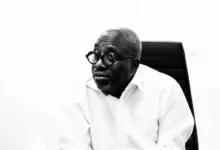
The first question was always:
“Where is your report card?”
And immediately after that:
“What books did you bring from school to study during your holidays?”
That was my father.
A man who believed education was not an option, not a luxury, and certainly not something you paused because you were on holiday.
And frankly, it used to annoy me.
So I decided to be cheeky.
I would come home with my report card… and my Bible.
He would look at the Bible with disgust and say:
“I am not educating you to become a Bishop. Where are your books?”
And I would respond with the arrogance of a teenager:
“This is holiday time. I am not going to spend it reading school books.”
My entire holiday depended on the contents of that report.
If it was good, I might get a few weekends of freedom.
If it was bad, I would end up in his law chambers on the 18th floor of Western House, Lagos, sitting in the law library “studying.”
In reality, I was watching horse racing below at Tafawa Balewa Square.
Because that was once the heart of Lagos society.
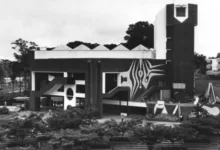
And destroying that race course to build that ugly monstrosity called the Tafewa Balewa was, in my opinion, one of the great cultural mistakes of modern Nigeria.
⸻
The Day I Insulted the Architect to His Face
One day, I was having dinner with an English architect who lived in Nigeria, Robin Atkinson.
His son Christopher was at Millfield with my siblings.
The subject of the stadium came up.
I was twenty-two, fresh out of university, full of fire, full of opinions.
And I went off on a full tirade.
I called it ugly.
I called it a disaster.
I said it ruined horse racing.
I said it killed a whole Lagos culture.
And then I concluded dramatically:
“Whoever built that bloody thing should be shot.”
Robin Atkinson sat quietly, staring at me.
Then he said calmly:
“I designed it. I am the architect Gowon commissioned to construct it.”
That is my life.
Always in the wrong place, saying the right thing.
⸻
Horse Racing Was Lagos
Lagos was not always chaos and traffic.
It had rhythm.
It had tradition.
Horse racing was not just sport. It was entertainment. It was prestige. It was high society. It was identity.
My father was one of Nigeria’s major horse racing owners.
He owned twenty champion horses.
The race course gave Lagos character.
And then along comes Gowon, and over a century of Lagosian culture is wiped out like it never mattered.
Nigeria has a dangerous habit of destroying its own history, then complaining that it has no national pride.
⸻
Even the Polo Club Was Almost Destroyed
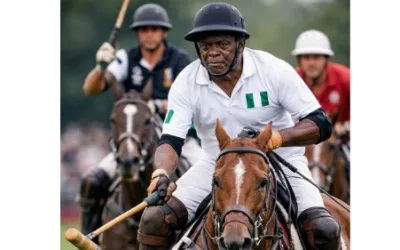
Gowon was going to destroy the Lagos Polo Club as well.
He wanted a helicopter and plane landing strip next to Dodan Barracks.
But senior military officers who played polo confronted him directly.
Men like Hassan Katsina, Yar’Adua, and others told him bluntly:
Touch the polo club and you will be removed.
That was the only reason it survived.
Nigeria is full of stories like this.
Small things.
Details that citizens dismiss as insignificant.
But those “small things” are what make a nation feel like a nation.
They form the character of the country.
⸻
The Plaque That Meant Everything
At the Lagos Polo Club there was a plaque installed in 1910.
I loved that plaque.
Because it gave the club identity.
It made the club feel connected to global history.
It made Lagos Polo feel relevant in the polo world.
The plaque stated that the Lagos Polo Club was opened by the Kaiser of Germany, Wilhelm II, in 1910.
That plaque was history carved into metal.
A rare Nigerian artifact of prestige and international relevance.
Then the new club leadership removed it.
And when I asked what happened to it, they looked at me like I was mad.
They had no idea what I was talking about.
They did not understand its significance.
That is Nigeria in one sentence.
A country that throws away its own gold because it does not recognize value.
⸻
They Told Me I Could Not Enter
The last time I visited the club, I was told I could not enter.
Imagine that.
They told Kio Amachree he could not enter a club he was practically born into.
I had been part of that polo club since 1966.
My first polo pony cost fifty pounds.
I am old school.
I am part of that history.
But today the club has been turned into a drinking club for wealthy Yoruba elites, with no respect for tradition, no respect for legacy, and no respect for old members.
I decided then and there:
I would play polo only in England.
No more Lagos Polo Club.
⸻
The Irony of Nigeria
The irony is this:
That club was once 98 percent white membership.
And now black members are telling me I cannot enter.
Me.
A man who played high goal polo in Cirencester and at the Guards Club.
A man who defended Nigerian grooms and workers when racist British men abused them.
I fought racism at that club.
I beat up Mr Brown when he hit a groom with his whip.
I defended dignity.
And now the very people who inherited that club are behaving like the colonial masters they claim to hate.
I don’t think so.
Who are you?
Show some respect.
Learn how to treat people.
⸻
Nigeria’s Greatest Problem Is Not Lack of Wealth
Nigeria’s greatest problem is not oil.
It is not money.
It is not even corruption.
It is the inability to understand the value of history.
The inability to preserve tradition.
The inability to recognize the importance of culture, etiquette, identity, and continuity.
Nigeria is uphill backwards with weights on your legs…
When it could be downhill skiing all the way to the bank.