Minister launches WEIDE Fund to improve economic empowerment for women
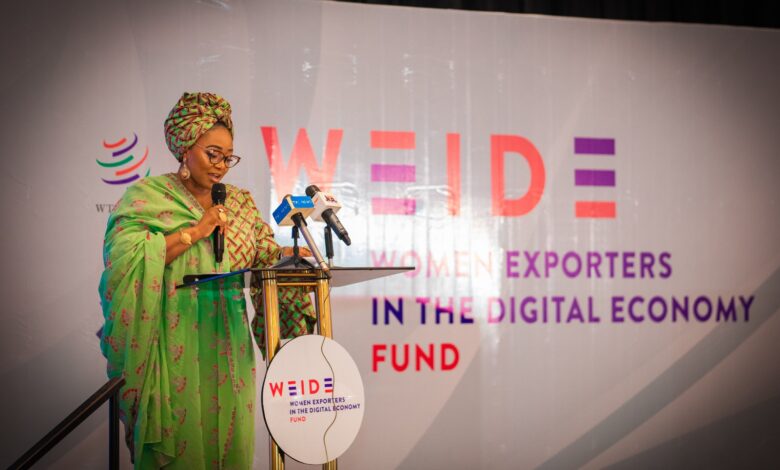
The Minister of Women Affairs and Social Development, Imaan Sulaiman-Ibrahim, has unveiled the Women Entrepreneurs and Innovators for Development (WEIDE) Fund in Abuja, describing it as a bold step toward transforming the economic fortunes of Nigerian women.
Speaking at the launch on Thursday, Sulaiman-Ibrahim declared that “the hands of our women will build the wealth of our nation,” emphasising that the initiative marks the beginning of a new era in women’s economic inclusion.
The programme, launched in collaboration with the World Trade Organization (WTO), was attended by WTO Director-General Dr Ngozi Okonjo-Iweala, whose presence the minister said highlighted the global importance of women’s participation in trade and innovation. She hailed Okonjo-Iweala as a “symbol of possibility and inspiration” for women worldwide.
Sulaiman-Ibrahim reaffirmed the Federal Government’s commitment to gender-responsive development under President Bola Tinubu’s Renewed Hope Agenda, stressing that “no country can close the economic gap without closing the gender gap.”




With the recently adopted National Women Economic Empowerment Policy serving as a framework, the minister said the WEIDE Fund would provide women with financing, tools, and market access in sectors such as agriculture, textiles, manufacturing, services, and the digital economy.
Citing statistics that women own 41 per cent of Nigeria’s micro-businesses but receive less than 20 per cent of available credit, she said empowering women economically could boost Nigeria’s GDP by up to 23 per cent by 2025.
She also celebrated the first batch of 146 Nigerian women entrepreneurs selected as WEIDE Fund beneficiaries, describing them as innovators, job creators, and ambassadors of national resilience. The minister expressed gratitude to First Lady Oluremi Tinubu for supporting women through the Renewed Hope Initiative, and to the Minister of Industry, Trade and Investment for promoting inclusive trade policies.
Sulaiman-Ibrahim called on government agencies, development partners, and the private sector to collaborate in building an inclusive economy powered by women’s innovation and resilience.