Talks happening at pace over Tel Aviv fan ban, says Downing Street
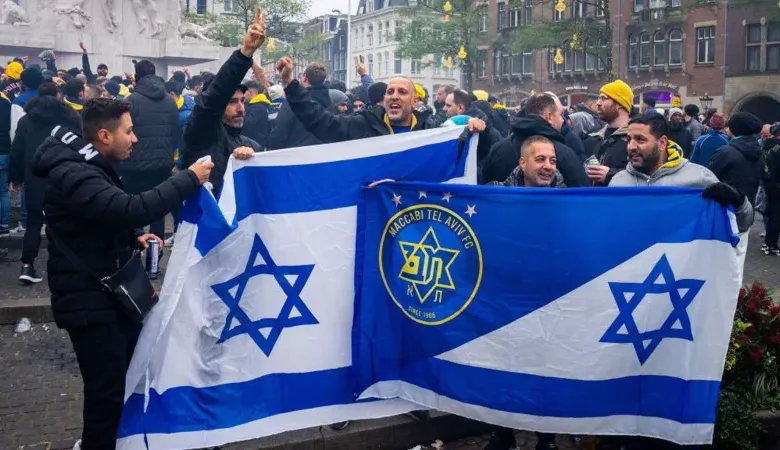
Talks are happening “at pace” to resolve a decision to block Maccabi Tel Aviv fans from attending a football match in Birmingham, the government has said.
Aston Villa said on Thursday the city’s Safety Advisory Group — responsible for issuing safety certificates — advised that fans of the Israeli club would not be permitted to attend the 6 November Europa League match.
The decision, supported by West Midlands Police, was criticised by Sir Keir Starmer.
On Friday, Downing Street said the Home Office is “urgently working to support police to try and find a way through this” and Culture, Media and Sport Secretary Lisa Nandy is meeting with officials.



On Thursday, West Midlands Police said the move to prohibit visiting supporters had been based on current intelligence and previous incidents, including “violent clashes and hate crime offences” between Ajax and Maccabi Tel Aviv fans before a match in Amsterdam in November 2024.
More than 60 people were arrested over the violence, which city officials described as a “toxic combination of antisemitism, hooliganism, and anger” over the war in Gaza, Israel and elsewhere in the Middle East.
Later on Thursday evening Sir Keir said banning Maccabi Tel Aviv fans from the fixture was the “wrong decision”, writing on X: “We will not tolerate antisemitism on our streets.”
A Downing Street spokesman said that blocking the football supporters was an “operational decision”, meaning that it was made by local authorities rather than the national government.
But he said: “We are perfectly entitled to speak out on fundamental principles of fairness like this.”
Downing Street said that Nandy is in discussions about “what more can be done to allow fans to attend the game safely”, he said. Meanwhile, Local Government Secretary Steve Reed spoke to the local council on Friday morning.
Simon Foster, West Midlands’ Police and Crime Commissioner, said he has asked the Safety Advisory Group and the police to meet “at the earliest possible opportunity and conduct an immediate review of the decision”.
He said the purpose of the review was to determine “whether or not this decision and recommendation is appropriate, necessary, justified, reasonable and a proportionate means of achieving a legitimate aim”.
Jack Angelides, chief executive at Maccabi Tel Aviv, said the decision to block fans of the football club had been “met with some dismay about what this is potentially signalling”.
Aston Villa said it was in “continuous dialogue with Maccabi Tel Aviv and the local authorities,” with the safety of supporters and local residents “at the forefront of any decision”.
Football’s European governing body Uefa said it wanted fans to be able to travel and support their team in a “safe, secure and welcoming environment”.
Uefa said: “In all cases, the competent local authorities remain responsible for decisions related to the safety and security of matches taking place on their territory.”
Chaired by Birmingham City Council’s head of resilience, the Safety Advisory Group is made up of officials from the local authority, emergency responders — including the police — and event organisers.
According to the council website, its role is to offer advice and guidance regarding public health and safety at events, including to “reduce any negative impact”, but it isn’t able to approve or reject them.
A council spokesperson said a meeting had been held with “all relevant partners to assess safety arrangements” for the fixture.
“Following a thorough review, concerns were raised regarding public safety if away fans attend the match, by the police,” they added. “As a result, a collective decision was made to restrict away fan attendance.”
Former Metropolitan Police chief superintendent Dal Babu said ensuring fans’ safety was not just about what happens in the stadium.
“It is managing the people travelling, people being dispersed from the ground,” he said. “And I think that makes it much more difficult to manage that across a much wider place.”
Ayoub Khan, an independent MP for Birmingham Perry Barr who campaigned on a pro-Gaza platform in last year’s general election, had pushed for the match to be cancelled and welcomed Thursday’s decision.
“From the moment that the match was announced, it was clear that there were latent safety risks that even our capable security and police authorities would not be able to fully manage,” he said.
He told BBC Newsnight the prime minister “should stay out of operational matters” and leave it to local authorities.
Khan added: “Nobody should tolerate antisemitism – we all condemned what happened in Manchester, that was clearly antisemitic” — referring to the deadly synagogue attack earlier this month.
“But we cannot conflate antisemitism when we look at what some of these fans did in Amsterdam in 2024. The vile chants of racism and hatred, the chants that there are no schools left in Gaza because there are no children left in Gaza.”
Andrew Fox, honorary president of Aston Villa’s Jewish Villans supporters’ club, said he thought Khan’s comments on Amsterdam were “shameful”, describing what happened there as a “premeditated Jew hunt”.
He added there are “political aspects” to the decision regarding the game in Birmingham that “go far beyond football”.
“The wider question is why there is a threat of violence,” Mr Fox said. “It’s not just about Maccabi Tel Aviv, it is obviously about much wider issues surrounding the Gaza war and that sends a really worrying message about British society that we aren’t civilised enough to have a debate over this without it descending into football violence.”
Emily Damari, a British-Israeli citizen who was held hostage in Gaza and released in January, said she was “shocked to my core with this outrageous decision”.
Describing herself as a “die-hard fan of Maccabi Tel Aviv”, Ms Damari said: “Football is a way of bringing people together irrespective of their faith, colour or religion and this disgusting decision does the exact opposite.”
Conservative leader Kemi Badenoch had earlier branded the move a “national disgrace”.
“If not, it sends a horrendous and shameful message: there are parts of Britain where Jews simply cannot go,” she said.
The decision was also criticised by the Liberal Democrats and Reform UK, as well as Israeli government officials.
The Green Party backed the decision and said it was “irresponsible” for Starmer to question a local authority’s safety decision.
Green deputy leader Mothin Ali said: “These games are taking place in the context of thousands of civilians being killed in Gaza, the illegal occupation of Palestinian land, and the upholding of a system of apartheid.”
Various sporting events have seen protests over the war in Gaza, including when Israel’s national team played Norway and Italy in recent World Cup qualifiers.
Earlier this month, 22 people were arrested near the Ullevaal Stadium in Oslo. Reports said tear gas was used after several demonstrators broke through police barriers.
A few evenings later, Israel’s national team played its next qualifier against Italy in the northern city of Udine, where an estimated 5,000 protesters took part in a march ahead of the game. Clashes with police broke out there too, with a number of people arrested.
There was also a protest in Spain on Wednesday over Euroleague’s basketball game between Valencia and Hapoel Tel Aviv, in which several people were arrested.
Credit: BBC