The age of the cheap kill: Why asymmetric warfare now decides wars — by Lim Tean
For three centuries, the calculus of war was brutally simple: mass beats weakness. Bigger armies, bigger navies, bigger budgets won. Clausewitz codified it, the World Wars proved it, and the Pentagon spent eighty years building an entire strategic culture around it.
That calculus is now dead. Ukraine and Iran, two states with no business defeating the powers arrayed against them, have killed it — not with theory, but with results.
The Numbers Russia Cannot Escape
When the war began in 2022, the consensus was unanimous: Ukraine’s population and military stood at a fraction of Russia’s, and attritional logic would grind it down within months. Four years on, the opposite has happened.




In March alone, Ukraine’s armed forces tallied over 35,000 Russian casualties in a single month — a new monthly record, up nearly 30 percent from February. Of those losses, Ukrainian officials attribute a staggering share to drones: Ukraine tallied Russian casualties at 35,351 in a single month, with drones causing 96 percent of them, while artillery and small arms fire accounted for the rest. Ukraine’s defence minister has said between 80 and 90 percent of Russian targets hit were destroyed by drones. Even the more conservative field estimates, drawn from the grinding attritional battles around Avdiivka, Vuhledar, and Toretsk, put the drone share of frontline casualties at 50 to 70 percent.
This is not a rounding error. It is a structural transformation of how wars are fought and won.
Finland’s president, Alexander Stubb, put the current kill ratio at roughly one Ukrainian soldier lost for every five Russian soldiers, with Russian losses running at 150 to 157 dead per square kilometre captured. Ukraine’s own presidential office has cited a similar figure — 316 casualties for every square kilometre Russia has captured in the first quarter of this year, more than double the rate from the year before.
Russia is not winning a war of attrition. It is losing one, at a cost it visibly cannot sustain: Moscow aimed to recruit over 1,100 contract soldiers a day this year, but by Ukraine’s tracking, actual recruitment has run at under 1,000 a day — a shortfall that compounds with every month of drone-driven slaughter.
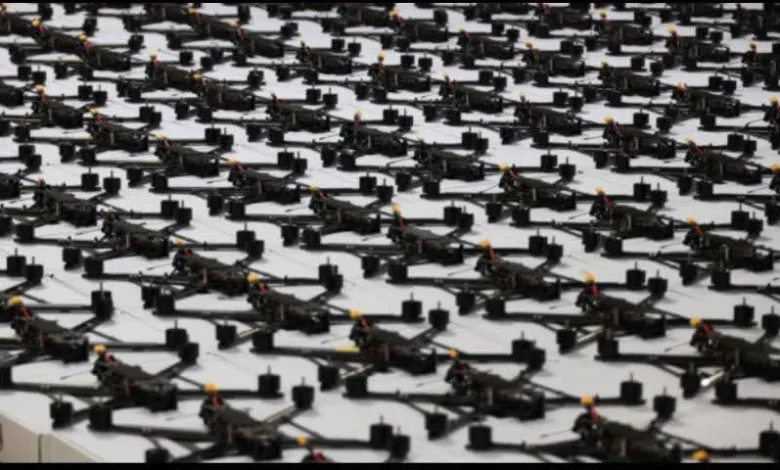
None of this was supposed to be possible for a country outnumbered and outgunned at the outset. Ukraine did not close the gap through Western tanks or artillery parity — it never achieved either. It closed the gap through ingenuity: mass-producing first-person-view drones by the hundreds of thousands, developing interceptor drones to shoot down Russia’s own Shahed swarms, and building an indigenous long-range strike capability that now reaches deep into Russian territory, with new Ukrainian-built ballistic missiles of 300km and 850km range approaching deployment — the longer of which can reach Moscow itself.
The scale of this industrial mobilisation is staggering in itself: Ukraine’s defence industry now has the capacity to produce more than 8 million FPV drones per year, an unprecedented figure for any country at war, and officials have said that with sufficient funding, this could be pushed even further. The constraint is no longer engineering or will — Ukraine has already demonstrated it can raise output to 7 to 8 million drones annually with proper funding — the constraint is money. A Ukrainian deputy defence minister has gone further still, telling NATO lawmakers that Kyiv’s defence industry could build up to 20 million drones a year if allies commit sufficient investment.
The country the world wrote off in February 2022 has instead demonstrated the single most important lesson in this article: numerical inferiority is no longer strategically decisive, if the weaker side is willing to out-innovate rather than out-produce.
The Economics No Great Power Can Escape
The deeper truth beneath the casualty figures is economic, and it is even more damning for the doctrine of conventional overmatch. An FPV drone costs a few hundred dollars. The tank, armoured vehicle, or soldier it kills represents an investment of millions.
Worse still for the defender: the interceptor systems built to stop these cheap weapons cost orders of magnitude more than the weapons themselves. A single Patriot interceptor can run into the millions of dollars — fired at a drone that cost less than a used car.
This is not a sustainable exchange rate for any state, however wealthy. It is the central strategic fact of the century: you cannot economically defend against a threat that costs 1,000 times less to build than the interceptor needed to stop it. No treasury, however deep, wins that arithmetic indefinitely.
This is precisely what unfolded when the United States went to war against Iran this year. Despite having no air force or navy capable of contesting American or Israeli power directly, Iran inflicted a cost the Pentagon had not budgeted for: the first 100 hours of the US-Israeli assault on Iran cost the United States approximately $3.7 billion, mostly unbudgeted, and congressional sources later put the ongoing daily cost at roughly $1 billion a day, with some Republicans privately fearing the true Pentagon spend was closer to $2 billion a day.
Iran achieved this not through a fleet or an air wing, but through what one analyst called a strategy of “forward deterrence” built on mass-produced drones, ballistic and cruise missiles, and hardened, dispersed facilities that make preemption difficult — precisely the asymmetric playbook Ukraine has independently arrived at from the opposite side of the map.
Iran’s Strategic Defeat of America
The war’s conclusion tells the same story as its cost. The Islamabad memorandum of understanding, signed in June, was framed by Washington as a negotiated settlement. It reads instead as a defeat.
The agreement commits the US and Iran to permanent termination of military operations, requires Washington to remove its naval blockade of Iran, and obliges the US to discuss sanctions relief, permit Iranian oil exports, and negotiate the nuclear question without imposing dismemberment of the program — this from a war that began with explicit demands for Iranian capitulation.
Even a neoconservative hawk like Robert Kagan reportedly warned that the confrontation with Iran could become one of the greatest strategic defeats in modern American history, a judgment the terms of the MOU appear to vindicate. CSIS, hardly a sympathetic voice toward Tehran, concluded plainly that both the United States and Iran will claim victory, but both have lost in important ways — a diplomatic way of conceding that the maximalist American objective was never achieved.
A state with no air force, no blue-water navy, and an economy crippled by sanctions fought the most powerful military alliance on earth to a negotiated draw that reads like American retreat. That is not an accident of this particular war. It is what happens when the economics of asymmetric warfare are allowed to play out to their logical conclusion.
Crimea: The Island Strategy
Nowhere is the strategic payoff of drone warfare more visible than Crimea. Ukraine has openly declared its intent to “isolate” the peninsula from Russia and turn it into an “island” — not through invasion, but through a sustained drone campaign against the roads, bridges, fuel depots, and power infrastructure that keep Crimea tethered to the Russian mainland.
The results have been extraordinary. In late June, Russian-installed authorities declared a state of emergency across occupied Crimea after weeks of punishing Ukrainian drone strikes disrupted water, fuel, and electricity supplies across the peninsula. Gas stations ran dry. Rolling blackouts halted water supplies that depend on electric pumps, and the Sevastopol governor confirmed that unstable power had caused water pressure problems, home to Russia’s Black Sea Fleet.
Even Vladimir Putin has been forced to concede the damage: he has admitted that Russia is suffering fuel shortages amid the sustained wave of Ukrainian strikes on Russian oil refineries, with electricity and water in Crimea being cut off and petrol nearly impossible to find.
This is not incidental damage. It is a deliberate campaign of strangulation. Ukraine’s military announced what it called a “logistics lockdown” of Crimea, with plans to systematically destroy Russian logistics, warehouses, equipment, command posts and supply routes at operational depth, and Ukrainian forces have gone as far as establishing de facto control over traffic on the federal highway connecting Russia’s Rostov region to Crimea through occupied Ukrainian territory.
All of this has been achieved with cheap, mass-produced drones striking bridges, fuel convoys, and power stations — not with tanks, not with an air force, not with a single warship.
The strategic implication reaches far beyond the peninsula itself. Crimea is not merely Russian-occupied territory — it is the logistical spine that sustains Russia’s occupation of the Donbas, Kherson, and Zaporizhzhia regions further north and east. If Ukraine’s drone campaign succeeds in permanently severing Crimea’s supply lines, isolating it as the “island” Kyiv intends, Russia’s ability to resupply, reinforce, and hold its remaining occupied territories collapses with it.
A Crimea cut off from the Russian mainland is not just a besieged peninsula; it is the beginning of the unravelling of Russia’s entire southern occupation. This is the deepest lesson of the drone war: cheap, expendable weapons are not merely killing soldiers on the front line. They are dismantling the logistical architecture an occupying power needs to hold territory at all.
The Doctrine That Must Now Change
Ukraine and Iran are, in strategic terms, mirror images of the same lesson delivered from opposite ends of Eurasia. The military logic each has exposed is identical: the side willing to trade cheap, mass-produced, expendable systems against expensive, exquisite, irreplaceable ones wins the war of attrition, even when it loses individual battles.
This has consequences far beyond Kyiv and Tehran. Every defence ministry that still measures strength in carrier groups, fifth-generation fighters, and armoured divisions is, to some degree, planning for the last war.
Nowhere is this clearer than Taiwan, where American and allied military advisers have been telling Taipei, in increasingly blunt terms, to stop trying to fight like a miniature version of the United States. The advice has a name: the “porcupine strategy,” a doctrine first proposed in 2008 that urges Taiwan to shift its focus away from high-value, easily targeted platforms such as advanced fighter jets and large naval vessels, and toward mobile, survivable, cost-effective systems — coastal anti-ship missiles, mobile air defence, sea mines, and above all, drones.
Defence analysts have been explicit that attempting to match China ship-for-ship or jet-for-jet would be prohibitively expensive and ineffective given China’s numerical advantage, and that those expensive legacy platforms would be particularly vulnerable to air and missile strikes — potentially rendering Taiwan defenceless within hours of a first strike.
Crucially, this is not merely an abstract doctrine — it is explicitly built on Ukraine’s example. A summary of dialogue between US and Taiwanese military analysts records the judgment plainly: “The Russian invasion of Ukraine was a sobering wake up call for Taiwan…As a result, Taiwan is placing increased emphasis on asymmetrical warfare and the development of homeland and territorial defense capabilities.”
And yet the advice has been resisted. Taiwan’s own defence establishment has clung to prestige purchases of American jets and warships, and the island’s most senior asymmetric-warfare advocate, Admiral Lee Hsi-min, saw his “Overall Defense Concept” quietly shelved after he left office. The obstacle has never been the strategy’s logic — Washington’s own advisers endorse it — but institutional vanity: the preference within Taiwan’s military for big-ticket items like fighter jets, submarines, and large warships over the unglamorous, dispersed, expendable systems that Ukraine has shown actually kill the enemy at scale.
Japan’s planners are watching the same lesson unfold, as they contemplate how a numerically inferior force might blunt a much larger one. The lesson is not that conventional forces are obsolete — they still matter for holding ground and projecting power. The lesson is that they are no longer sufficient, and that the nation which fails to build a deep, cheap, mass-producible drone and missile arsenal alongside its conventional forces will find itself bleeding out exactly as Russia has, at a rate its treasury and its manpower cannot replace.
The 21st century will not be won by whoever can build the most expensive weapon. It will be won by whoever can make the enemy’s expensive weapons irrelevant — cheaply, repeatedly, and at a rate the other side cannot afford to answer.