Why I declared women’s rights as human rights at 1995 Beijing Conference, by Hillary Clinton
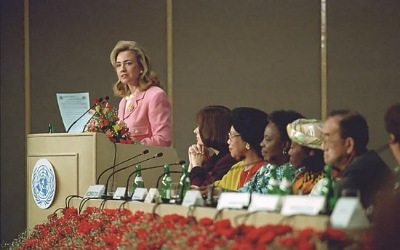
When the UN Fourth World Conference on Women met in Beijing in 1995, I wanted to go. If my husband hadn’t been president, I would have wanted to go as myself—a lawyer, an advocate.
But I knew that if I went as the first lady of the United States it would carry a message that would resound around the world: The United States is putting its leadership toward advancing the rights of women.
When I was working on the speech, which took many weeks, I was really focused on how to break through.
I wanted to push the envelope in the speech to state a simple truth: women and girls inherently have the same rights as men and boys.


After I got back from the conference, I did a lot of media. I remember a man from Iran calling in to the Voice of America and asking me: “When you say women’s rights are human rights, what can you possibly mean?” He was genuinely confused.
I said, “I want you to close your eyes and think about all the rights you have. And what I’m saying is your daughter, your sister, and your mother should have the same rights.” It was considered such an outlandish claim at the time.
The 1995 conference was historic for the gathering alone. But what was most significant was the platform for action that came out of it.
It was hammered out by delegates from 189 countries. The negotiation was hard-fought, and we were right in the middle of it. The result was a platform for action to not just change laws and regulations, but to begin to look at culture and traditions too.
Delegates took the platform and its principles home to their own countries. Here in the US, the agenda became a precursor for including women’s rights and needs as elements of America’s domestic and foreign policy.
Looking back, the conference deserves to be considered one of the seminal events of human history.
But the fight for women’s rights is, of course, unfinished. While there has been progress, there has been pushback.
What gives me hope is that in the past 30 years, generations of women and girls and men and boys have grown up with the notion that “women’s rights are human rights” is not controversial in the least. It’s just true. So we will keep marching.