Kashim Shettima: Chosen by providence, refined by kindness — by Babazanna Abdulkarim
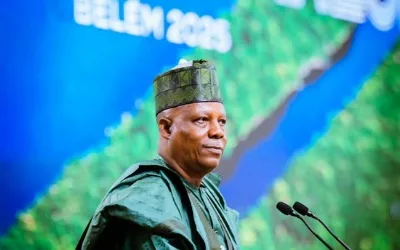
In the rough and tumble arena of Nigerian politics, where political capital is often measured in decibels rather than deeds, and where loyalty is frequently a function of patronage, the ascent of His Excellency Kashim Shettima defies every established playbook. To observe his trajectory from an academic intellectual to the Governor of Borno State, and ultimately to the Vice Presidency of Nigeria, is to witness a narrative that feels increasingly anachronistic in the 21st-century political landscape. It is a story that forces a singular, uncomfortable question upon the observer: In a system designed to reward the loudest and the most connected, what happens when a man is elevated not by his hunger for power, but by a convergence of fate, intellect, and an almost old-fashioned sense of humanity?
The answer, it seems, is that he becomes a political paradox.
His Excellency Shettima’s story begins with the weight of providence. When he assumed the governorship of Borno State in 2011, he was not stepping into a normal political office; he was stepping into the epicenter of a national trauma. Borno was, at the time, the cradle of an insurgency that threatened to tear the nation apart. Most political prognoses suggested that a “technocrat” or a “security hawk” would be required, a man of hard edges. Instead, fate delivered an academic, a former lecturer and banker with a soft-spoken demeanor. On paper, it was a mismatch. In practice, it was a masterclass in the idea that sometimes, Providence selects the person best suited for the aftermath, not just the battle.
It was in the rubble of Maiduguri that H.E. Shettima’s governing philosophy was forged. While the world saw a theater of war, he saw a wounded family. His response was not merely strategic; it was deeply psychological. He understood that a state cannot be rebuilt with bullets alone; it must be rehabilitated with trust. His administration’s focus on reconstructing homes, reopening markets, and, most critically, investing in the psychological welfare of a traumatized populace was a departure from the militaristic orthodoxy. This was kindness as statecraft,a radical notion in a region crying out for rescue.




This leads to the second, and perhaps more politically profound, layer of his ascent: the weaponization of intellect. In Nigerian politics, intellectualism is often viewed with suspicion. The “street” values the man who can speak in proverbs and wield influence through sheer will. But Shettima wielded his mind like a scalpel. As governor, he was notorious for his grasp of microeconomics and fiscal prudence, often, his forensic understanding of where resources should go is remarkable outstanding.
However, his true intellectual distinction lies in his ideological consistency. In a political climate where politicians switch parties with the frequency of changing clothes, H.E. Shettima remained anchored. His intellectualism is not the shallow erudition of the elite; it is a functional, ideological compass. It was this clarity of thought that made him a natural ideological foil to the more transactional elements within the ruling All Progressives Congress (APC). He represents the cerebral wing of the progressive movement—the belief that policy, not just politics, should dictate governance.
Yet, to speak only of providence and intellect is to miss the soul of the argument. The most politically subversive element of H.E. Shettima’s career is his kindness. In a system built on the currency of favors, kindness is often mistaken for weakness. But His Excellency has weaponized empathy. His legendary generosity is not merely a personal virtue; it is a political architecture. By investing in the humanity of the common man, whether through educational scholarships for the less privileged or by sharing meals with the internally displaced during Ramadan, he built a constituency that does not rely on the usual ethnic or sectional appeals.
This approach challenges the very foundation of Nigeria’s political economy. Typically, a politician’s power is derived from how many people he can control. His Excellency Shettima’s power is derived from how many people he has lifted. In the North-East, he is not revered because he is the Vice President; he is revered because when Borno was bleeding, he stayed, he wept, and he rebuilt. That emotional capital is a currency far more stable than the volatile naira of political patronage.
As Vice President, this trio of attributes, providence, intellect, and kindness takes on a new dimension. In the current administration, he often serves as the quiet, stabilizing intellectual anchor. In a government tasked with the audacious mission of resetting Nigeria’s economic foundation (through subsidy removal and fiscal reform) and reimagining its security architecture, Shettima represents the ideological consistency of the “Renewed Hope” agenda. His role is not that of the attack dog, but of the strategic thinker who understands that policy decisions have human faces.
His presence in the Villa is a quiet rebuke to the cynics who believe that Nigerian politics has no room for the refined. It suggests that while money and muscle can buy a ticket to the game, they cannot manufacture the confluence of timing, moral grounding, and intellectual heft that defines true leadership.
In a country weary of loudmouths and desperate for substance, the ascent of His Excellency Kashim Shettima offers a seductive thesis: that perhaps the old ways are dying. Perhaps, after decades of brute force politics, there is still room for the man chosen by Providence, refined by kindness, and sharpened by an intellect that refuses to be dulled by the noise of power.
His story is not just a biography; it is a blueprint. It argues that in the end, the leaders who endure are not those who seek power with the most aggression, but those upon whom power is bestowed by the weight of history—and who have the character not to squander it. Whether this model can be replicated, or whether it remains a singular anomaly in Nigeria’s complex political chemistry, is the question that will define the coming era. For now, it stands as a testament to the radical idea that in politics, as in life, being a decent human being might just be the ultimate political strategy.



Even Devil children are praising him how much more politicians