Nigeria, Benin Republic sign pact to drive trade, development in border areas
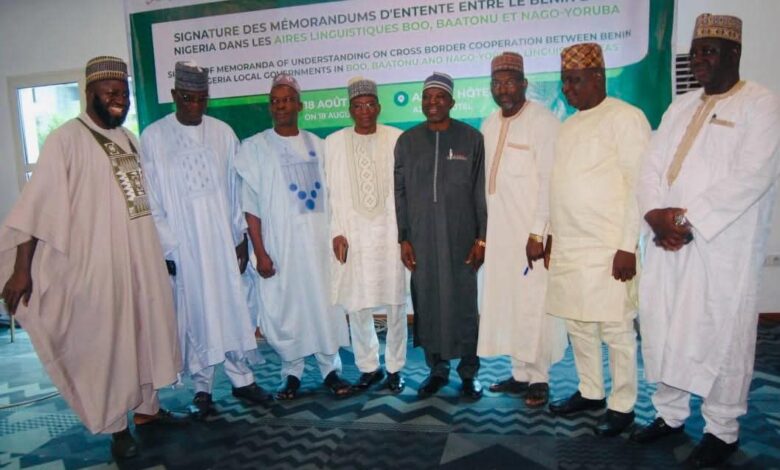
Nigeria and the Republic of Benin have signed a Memorandum of Understanding (MoU) to strengthen grassroots cross-border cooperation. The agreement, signed on August 18, 2025, aims to strengthen collaboration between local government authorities and traditional institutions along the shared frontier.
The MoU, anchored on the African Union Convention on Cross-Border Cooperation, ECOWAS Cross-Border Initiatives, and the Nigeria–Benin Cross-Border Agreement, formalizes cooperation between Nigeria’s border local government chairmen and Beninese mayors, alongside traditional rulers from both countries.
Its key objectives include enhancing resilience of border communities against crimes, reviving socio-cultural linkages disrupted by colonial demarcations, and fostering peaceful coexistence. It will also accelerate boundary delimitation and promote stability through grassroots participation.
The agreement goes beyond security by encouraging joint initiatives in trade, agriculture, infrastructure, and cultural exchanges as practical ways to improve livelihoods and boost regional integration in line with ECOWAS goals.



Nigeria’s delegation was led by the Director-General of the National Boundary Commission (NBC), Surv. Adamu Adaji, and included officials from the Ministries of Foreign Affairs and Justice as well as chairmen of border LGAs in Kebbi, Niger, Kwara, Oyo, Ogun, and Lagos. The Nigerian Embassy in Cotonou also provided diplomatic support.
Adaji described the MoU as a “grassroots-driven instrument” that must move beyond paper to deliver tangible results. He emphasized Nigeria’s determination to ensure the agreement benefits border communities directly.
Hon. Idris Mohammed, Chairman of Baruten Local Government in Kwara, and Mr. Joseph Ahoyo, Mayor of Malanville in Benin, welcomed the pact as a timely step to address insecurity, disrupted trade, and cultural isolation. Traditional rulers were also identified as key partners in its implementation.
Officials said the agreement would be followed by joint dialogue platforms and pilot projects in security, trade, and cultural revival. Adaji concluded that the MoU represents “a pledge to our people that we will work together across borders to build safer, stronger, and more prosperous communities.”