NMDPRA laments over West Africa countries reliance on global oil price trading activities
Despite being a significant producer of hydrocarbon resources, an important consumer of refined petroleum products and a growing refining hub, the Nigerian Midstream and Downstream Petroleum Regulatory Authority (NMDPRA) on Tuesday lamented over West Africa continues dependency on posted prices of global reference markets such as Northwest Europe (NWE), US Gulf Co ast, Mediterranean, Singapore, Arab Gulf etc for all its trading activities.
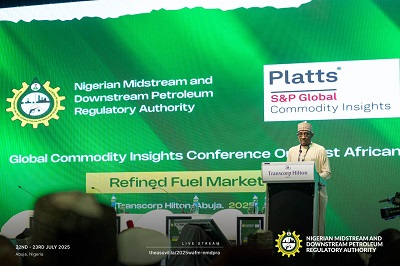
The NMDPRA Chief Executive, Farouk Ahmed, disclosed this while speaking at the West African Refined Fuel Conference in Abuja, organised by NMDPRA and S&P Global Commodity Insights.
“While these benchmarks are globally accepted, often they do not reflect the unique supply chain peculiarities, market dynamics, and economic realities of the African continent. A regional pricing benchmark that promotes price discovery, transparency, deepened market development and enhanced availability of energy has then become a strategic objective that requires the collaborative action of all the stakeholders that are major players in this market,” he said.
Ahmed explained that West Africa’s fuel landscape is still reliant on external sources, with 69 per cent of fuel imports accounting for 1.44 million metric tons out of the total 2.05 million metric tons traded in the region per month.




“Our 2025 statistical data for fuel supply in the West African region reveals that 2.05 million MT per month of gasoline is being traded,consisting of 1.44 million MT (69 per cent) imports and 0.61 million MT (31 per cent) refinery contribution from the region,” Ahmed said.
He added that the regional supply of fuels in West Africa has grown through improved refining capacities in Nigeria, Ghana, Niger, Senegal and Cote D’Ivoire which currently stands at 1.335 million barrels per day.
Furthermore, he said the 2025 OPEC World Oil Outlook projects 1.2 million barrels per day additional refining capacity in Africa, between 2025 and 2030.
He noted that the West African region will make significant contributions to this projection through new projects, upgrades and rehabilitations, which are currently at various levels of completion in the different countries.
“These increased refining capacities will improve the market liquidity of refined petroleum products in the region. Nigeria is rapidly evolving into a midstream and downstream trade and logistics centre.
“Nigeria has an active maritime coastline that links all West African markets, deep seaports with modern technologies and infrastructure, as well as regulatory frameworks that support World class standards of maritime operations. These factors have positioned the country as a viable hub in the West African energy sector,” he said.
Also speaking, Ikeagwuonu Ugochinyere, Chairman, House Committee on Petroleum Resources (Downstream) said the Nigerian energy sector is poised for significant growth and development, driven by a shared vision among stakeholders for a competitive West African energy market.
This vision, he said, emphasises the importance of adequate local refining capacity, transparent and efficient fuel markets, and stable regulatory environments that attract private sector investment.
“Achieving this vision demands shared responsibility among regulators, industry players, development institutions, and the legislature. We must innovate, digitize, and humanise our regulatory approaches ensuring that policy serves the people while enabling growth.
“We must strive to eschew monopolistic tendencies that are more likely to create unfavourable conditions for the Nigerian Petroleum market and likely to be at variance with the various anti-trust laws,” he said.