Rising cases of abuse of house-helps among Igbo women — by Kelechi Deca
Thousands of years ago, our ancestors were bogged by an intellectual dilemma where certain things seem to have a constant repetition of outcomes with accurately targeted recurring certainty.
Worried about such effects, they asked the now famous yet answered rhetoric question:
“Agbaa akụ nke mbu, ọ daa n’ogwe, agbaa nke abụọ ọ daa n’ogwe, emere ogwe na akụ!”
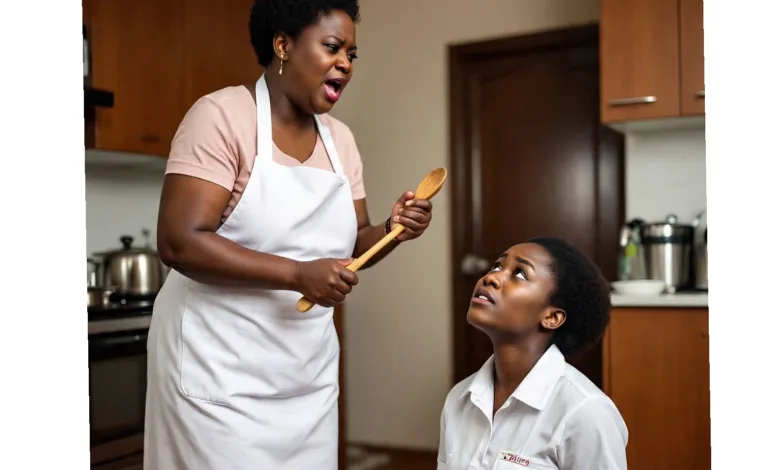
Nothing seems to capture that clearer than the unfortunate and shameful rise in the cases of abuses of house-helps amongst Igbo women which in itself represents a disturbing paradox.




A paradox because it juxtaposes the Igbo woman’s historic role as a protector of the oppressed, a nurturer, and a voice of the voiceless, with an emerging pattern of inexplicable aggression against the most vulnerable.
Recent cases detailing the use of pestles, boiling water, electric irons, knives and even “peppering,” on children as young as seven for trivial domestic offenses, have rightfully ignited public outrage.
However, the rate at which new cases emerge daily is so disturbing that the communities, the government and civil society organisations must rise to protect these vulnerable children.
This development also demands academic excursions especially by the University of Nigeria Nsukka’s Faculty of the Social Sciences to dig into the immediate or remote causes of the problem and help us understand what is actually happening.
This is not to deny the fact that we have always had cases of wicked step-Mother Syndrome and by extension Aunty’s and who take out whatever bottled frustrations they feel on the most vulnerable figures under their care and authority.
But the present rate of occurrences of these abuses is quite disturbing, and frighteningly so, against the backdrop of the rising levels of female literacy in the South East, which is the highest in the country, if not entire West African region. Effectively staining their academic accolades.
Perhaps, most of these brutal exhibitions can be understood through a lens of psychological transference and power dynamics within families.
Those who found themselves within a family structure that often subordinates them, may develop feelings of powerlessness and frustration.
And a house-help, often from an impoverished background or dependent relative with no social power, becomes a convenient target for the displaced anger a woman feels in her marital home.
Unfortunately, this is compounded by the internalization of normalized violence, where aggression is viewed as an acceptable form of discipline, and a lack of empathy, where the maid is dehumanized as mere property rather than a child.
The desire to project authority in a space where one may feel controlled under toxic environment can lead to these extreme and tragic outbursts.
There is need to critically and holistically analyze this crisis to understand the possible psychological underpinnings of this abuse, and propose a path toward resolution, using established cultural platforms.
This is why I humbly propose that the single overarching item on the agenda of all the women’s wing of all town development associations, and improvement unions across Igboland attending this year’s August Meetings, must as a matter of urgent communal existential importance, look inwards, and in all sincerity ask themselves questions: O gini n’ afio?
The annual August Meeting presents a powerful and culturally resonant platform to confront this menace.
Historically, these gatherings have been instrumental in complementing development and infrastructural projects in the communities; it has also served as platforms in tackling regressive cultural practices.
The same collective resolve can be mobilized to protect the girl-child. Women can use this forum to launch sensitization campaigns on the psychological and legal consequences of abuse, leveraging the VAPP Act of 2015.
The August Meeting can establish community watchdogs tasked with visiting homes to check on the welfare of house-helps, creating an “honor system” that discourages maltreatment.
Also the need to escalate the “if you see or hear something, say something” regarding maltreatment of helps should be widely embraced.
Ultimately, the solution lies in re-education and shared accountability. The August Meeting provides the perfect stage for psycho-social seminars that promote positive parenting and non-violent conflict resolution.
By publicly addressing the systemic failures which allows such atarvistic abuses to take place, especially husbands who use excuses of being busy to abdicate responsibilities.
And also those helplessly emasculated men who have been cowed into acquiescence by the Tigresses they live with as wives, watching and sometimes being accessories to such crimes.
Igbo women can reclaim their role as societal guardians. It is imperative that this platform transforms from a primarily social event into a robust instrument for social justice, ensuring that the dignity of every child, irrespective of their status, is protected.
For a demographic whose illiterate great-grand mothers and grandmothers rose in unison to confront the British colonialists almost 100 years ago, with just a single literate woman amongst them Mary Okezie (Mary Ogu Ndom), who did all the reading and writing on their behalf.
The question presently beggars the true impact the high literacy rate has had on some of these women if this level of crudity and primitive infliction of pain against hapless children has become their ways of lives.
This is the time to rise to the occasion and revolt against this iniquity that has become cankerworms, slowly eating up the social fabrics of our communal existence.
Our ancestors said that “Unless the rashes of the buttocks are publicly disgraced by subjecting them to the indignity of nakedness, they’ll never heal.”
E mee ngwa ngwa, emeghara o dashi.