Sanwo-Olu completes 362 roads across 347km in seven years
By Adeola Ogunrinde
The Lagos State Government has announced the completion of 362 roads covering about 347 kilometres across the state since 2019, alongside major investments in healthcare, justice administration, education, public safety and digital infrastructure.
The government said the projects, executed under the administration of Governor Babajide Sanwo-Olu, are intended to improve transportation, boost economic productivity, enhance public service delivery and cater to the needs of the state’s rapidly growing population.
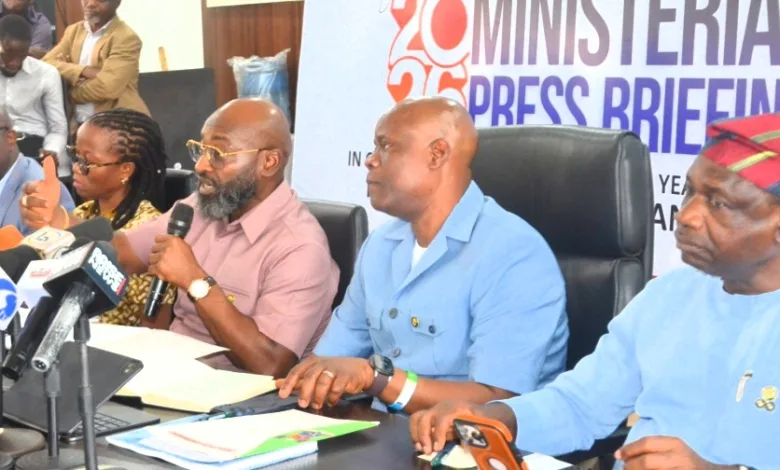
Speaking during the 2026 Ministerial Press Briefing held in Alausa on Monday, the Special Adviser to the Governor on Infrastructure, Engr. Olufemi Daramola, said the administration had maintained an aggressive infrastructure renewal programme despite economic challenges and rising construction costs.

Daramola disclosed that 130 roads spanning approximately 113 kilometres were completed within the last year, adding to several projects already commissioned across Lagos’ five divisions. He listed key projects delivered during the review period to include the Opebi-Mende Link Bridge and approach roads, Babajide Sanwo-Olu Road in Agege, Abaranje Road in Alimosho, as well as major road projects in Badagry and Ikorodu.
He added that a number of strategic projects have been completed and are awaiting commissioning. These include sections of the Eti-Osa-Lekki-Epe Expressway corridor, Gberigbe Road in Ikorodu, Aka-Kemberi Road in Ojo, Ijegun-Ijagemo Road and Akesan-Igando Road in Alimosho.
According to him, the state is pursuing a long-term infrastructure strategy focused on building resilient facilities that support economic activities, improve mobility and enhance the quality of life for more than 20 million residents. He noted that the projects are designed to strengthen critical economic corridors and prepare Lagos for future growth.
Also speaking, the Special Adviser to the Governor on Works, Dr. Adekunle Olayinka, said the administration’s infrastructure-led development agenda is addressing longstanding deficits while creating a foundation for sustainable economic expansion. He noted that work is progressing on major projects such as the Bola Ahmed Tinubu Administrative Complex and Revenue House in Alausa, which are expected to improve public service efficiency and provide modern office facilities for government operations.
Olayinka further revealed that construction is ongoing on a 280-bed General Hospital in Ojo, a 150-bed Massey Children’s Hospital and a 1,500-bed Psychiatric Hospital and Rehabilitation Centre in Ketu-Ejinrin. He said the projects would expand access to quality healthcare and generate employment opportunities. Other projects highlighted include the redevelopment of the J. Randle Centre for Yoruba Culture and History, remodelling of Teslim Balogun Stadium, construction of an elderly care home in Epe, new fire stations, police barracks and a state data centre. Daramola added that about 30,000 kilometres of fibre duct infrastructure had been facilitated across the state, attracting roughly $22 million in foreign direct investment for fibre-optic expansion, even as officials acknowledged challenges posed by flooding, climate change, rising costs and infrastructure vandalism.