Senate approves N54.46trn, fixes capital expenditure at N20.131trn for 2026 budget
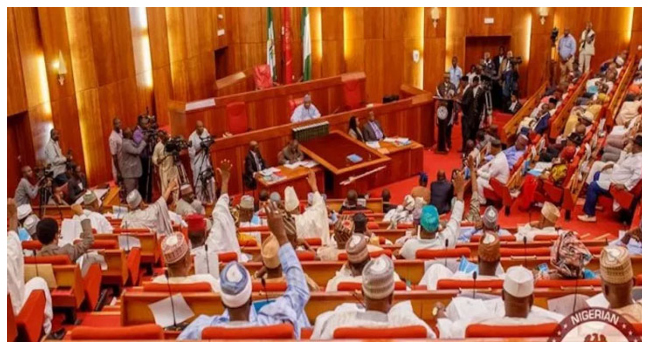
The senate has approved N54.46 trillion for the 2026 budget as President Bola Ahmed Tinubu is set for the presentation of the Federal Government’s 2026 expenditure plan.
The approval of the 2026 – 2028 Medium Term Expenditure Framework and Fiscal Strategy Paper (MTEF/FSP) was after the Senate in plenary granted approval on Tuesday.
The lawmakers also pegged capital expenditure at N20.131trillion, recurrent expenditure at N15.265 trillion, statutory transfers at N3.152trillion, and Sinking Fund at N388.54billion.
Also, the Senate approved the $60 per barrel as oil benchmark (down from N64.85 proposed by the executive), projected aggregate revenue of N34.33trillion, fiscal deficit of N20.13 trillion, borrowings at N17.88trillion, debt service of N15.52trillion, pensions, gratuities, retirees’ benefits of N1.376trillion, 1.84 mbpd as crude oil production, inflation rate of 16.5 per cent, exchange rate of N1,512 per $1 and GDP growth rate at 4.68 per cent.




The approval of the fiscal document followed the presentation and consideration of the report of the Senate Committee on Finance during plenary.
Minister of Finance and Coordinating Minister of the Economy Wale Edun said N10.7 trillion is the estimated revenue inflow for 2025 against the projected N40.8 trillion.
The report was presented by the committee Chairman, Senator Mohammed Sani Musa (APC – Niger East).
After due consideration by the lawmakers, the following recommendations of the Committee were approved.
They include: “That the projected crude oil benchmark prices of US$64.85, US$64.30 and US$65.50 per barrel for 2026, 2027 and 2028, respectively, be reduced to US$60 for 2026, US$65 for 2027 and US$70 for 2028.
“This is in recognition of the global geopolitical tensions in Europe and the Middle East and the sensitivity of the global crude oil price.
“The projection for domestic crude oil production for 2026, 2027 and 2028 is 1.84 mbpd, 1.88 mbpd and 1.92 mbpd, respectively be sustained.
“The projected exchange rates for 2026, 2027 and 2028 are N1,512, N1,432.15 and N1,383.18, respectively, and should be sustained in line with CBN’s policy to stabilise the naira and promote effective fiscal and monetary policy coordination.
“Inflation rates projections for 2026, 2027 and 2028 are 16.5 per cent, 13 per cent and nine per cent, respectively, be sustained based on the commitment of the nation’s monetary policy authority to moderate inflationary pressure.
“The GDP growth rate is projected at 4.68 per cent, 5.96 per cent and 7.9 per cent for 2026, 2027 and 2028, respectively.
“Amidst reform in the Nigerian economy and prospects for reforms to take effect in 2026, it recommended that the projection for real GDP be sustained.
“The real GDP growth rate, projected at 4.68 per cent, 5.96 per cent and 7.9 per cent for 2026, 2027 and 2028, respectively, be sustained in anticipation of the gains of Tax reforms.”
The committee called for “effective implementation of the new Tax Acts as veritable instruments for economic reforms for growth and development.”
It added: “In line with the ongoing economic reforms and the activation of the Tax Act, it is recommended that the Federal Government implement a National Scanning Policy within the National Single Window of the Nigeria Revenue Service (NRS), in collaboration with the relevant Agencies.
“This will enhance revenue assurance, improve trade facilitation, reduce leakages, and strengthen transparency and national security.”
Edun said the Federal Government recorded a significant revenue shortfall in the 2025 fiscal year.
He spoke while appearing before the House of Representatives Committees on Finance and National Planning during an interactive session on the 2026–2028 MTEF and FSP.
According to him, the Federal Government initially projected revenue of N40.8 trillion for 2025 to fund the N54.9 trillion “budget of restoration” to secure peace and rebuild prosperity.
However, current performance indicates that total revenue for the year is likely to end at about N10.7 trillion, he said.
The minister attributed the shortfall mainly to weak oil and gas revenues, particularly Petroleum Profit Tax (PPT) and Company Income Tax (CIT) from oil and gas companies, as well as underperforming subheads.
“The current trajectory indicates that federal revenues for the full year will likely end at around N10.7 trillion, compared to the N40.8 trillion projection,” Edun told lawmakers.
He added that while the government had also borrowed about N14.1 trillion, the combined inflows remained far below what was required to fully fund the 2025 budget.
Despite the shortfall, Edun said the government had met key obligations through what he described as prudent treasury management.
He noted that salaries, statutory transfers, and domestic and foreign debt service had been paid as and when due through “skilful, imaginative and creative handling” of available resources.
Providing an update on expenditure performance, the minister said capital releases to ministries, departments and agencies (MDAs) in 2024 stood at N5.2 trillion out of a budgeted N7.1 trillion, representing 73 per cent performance, while total capital expenditure, including multilateral and bilateral projects, reached N11.1 trillion out of N13.7 trillion, or 84 per cent.
Edun urged that expenditure plans tied to oil revenues should remain flexible, cautioning against committing the government to obligations based on projections that had repeatedly failed to materialise.
“We must be ambitious, but given the experience of the past two years, spending linked to these revenues must depend on the funds actually coming in,” he said.