Von-Batten: A black sheep’s $700 billion perfidy — by Olabode Opeseitan
There is a Yoruba proverb for households that seem improbably calm: Bi ile kan ba’n toro, omo ale ibe ni ko ti d’agba. If there is peace and tranquillity in a family, it is because the black sheep of that family has not yet come of age. Nigeria’s black sheep came of age this month, and he did so wearing a borrowed surname. Karl Von Batten, the Washington lobbyist who spent late September insisting that a $700 billion mining pact between Nigeria and the United States was a mirage, was born Ikemefuna Okeke. He is a Nigerian who reportedly acquired the name Von Batten through marriage to Elizabeth Von Batten, and who now presents himself, in the fluorescent light of American policy circles, as something closer to Dutch aristocracy than the son of the country he spends his days disparaging.
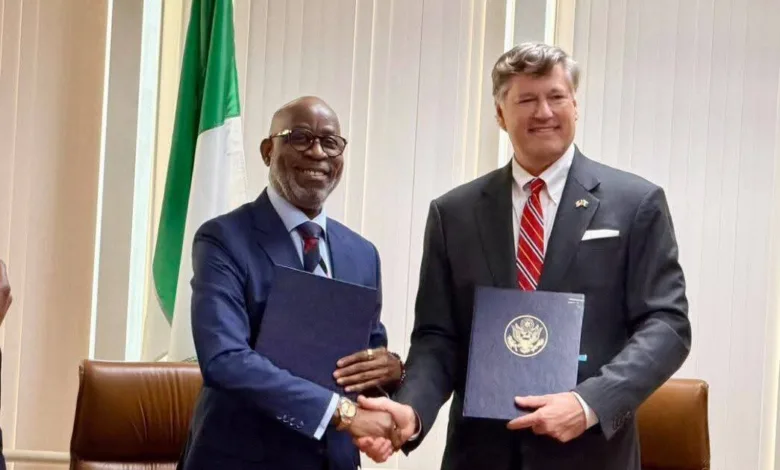
The pact he was belittling is real, and it is substantial. On the 23rd to 24th of this month, Nigeria’s Minister of Solid Minerals Development, Dele Alake, and United States Deputy Secretary of State Christopher Landau signed a framework agreement at the Nigerian Mission House in New York, on the sidelines of the 81st UN General Assembly. It covers geological data and exploration, mineral development and processing, infrastructure and technical capacity building, and it is built on Nigeria’s estimated $700 billion in untapped mineral wealth: lithium, gold, tin, gemstones, iron ore and phosphate. For Nigeria, the appeal is obvious: a route out of raw-material dependency towards local processing and value addition. For Washington, it is a hedge against a Chinese-dominated critical-minerals supply chain, secured through a partner willing to build capacity rather than merely export ore.
Von Batten’s account of this, posted through his firm’s social media account, told a different story: that the MOU was a desperate, last-minute offer Asiwaju Bola Ahmed Tinubu dangled for a meeting with Donald J. Trump, that his firm’s intervention got the signing cancelled, that Tinubu was stranded in France after being denied, and that the United States simply took the mines while giving Nigeria nothing. Each claim collapses on contact with the record.
The idea that this was sudden is false. Alake led a Nigeria Solid Minerals Company delegation to the White House in early August 2026, meeting David Copley of the National Security Council to discuss exactly this value chain. That was followed by talks with the US Chargé d’Affaires in Abuja, and by 13 September Nigerian officials were already publicly targeting a UNGA signing, months before Von Batten’s “last week” framing. Nor was the signing cancelled: it happened precisely as scheduled, with Alake and Landau exchanging documents in front of cameras, followed by press releases from both governments.



Tinubu’s absence had nothing to do with any of this. He was on a pre-announced working leave in Europe, with Vice President Kashim Shettima leading Nigeria’s delegation, marking the third consecutive year Tinubu has skipped UNGA in person. And the “mines” were not taken. What was signed is a non-binding government-to-government framework, intended to set conditions for later business-to-business investment; Alake himself has said the next task is identifying viable projects, not handing over deeds.
As for the man behind the claims: Karl-Marx Edward Okeke-Von Batten, sometimes filed as Ikemefuna Okeke, runs Von Batten-Montague-York, a firm registered as a foreign agent under FARA. Earlier this year he claimed appointment to a White House policymaking role, a claim his own firm deleted after the White House stayed silent, and which Nigerian officials say was in fact an unpaid seat on a presidential scholars’ education commission, nothing more. He has also fed Trump administration officials and congressional staff old US Justice Department records concerning Tinubu, and is currently trading multimillion-dollar lawsuit threats with Nigeria’s ambassador to South Africa.
None of this is incidental. Von Batten’s firm signed a 12-month, $1.2 million retainer with Atiku Abubakar, a politician who turned from a benefitting ally to Tinubu’s perennial rival and the 2027 opposition candidate, explicitly to counter progress made by Nigeria under the Tinubu government.
The proverb endures because it names something structural, not incidental: the disruption in a household so often comes from within, dressed convincingly, waiting only for its moment. Nigeria’s peace this September was threatened not by Washington, nor by any failure of diplomacy, but by a man who renamed himself to sound less like home, paid to sabotage his own native land.
Opeseitan is Editorial Architect |
Strategic Communicator