Why support for MSMEs is central to our development agenda — Sanwo-Olu
By Adeola Ogunrinde –
Governor Babajide Sanwo-Olu has reaffirmed that supporting Micro, Small and Medium Enterprises (MSMEs) remains a core pillar of his administration’s development agenda, noting that the sector drives productivity, job creation and the state’s economic stability.
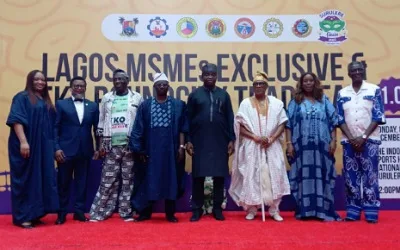
Speaking through the Chairman, House Committee on Commerce, Cooperative, Trade and Investment, Hon. Abiodun Tobun, at the opening ceremony of the maiden Lagos MSMEs Exclusive and Eko Roundcity Trade Fair at the National Stadium, Surulere on Monday, Sanwo-Olu said the significance of MSMEs to the state’s economic growth cannot be overstated.
He noted that Lagos, responsible for 30 to 35 per cent of Nigeria’s Gross Domestic Product (GDP) with an estimated economic value of $259 billion, relies heavily on the daily output of thousands of small businesses across its markets, industrial clusters and creative hubs.


Sanwo-Olu highlighted the contributions of local traders in Balogun and Alaba, fashion designers in Surulere and Yaba, tech innovators in Lekki and Ikeja, agro-processors in Epe and Ikorodu, and countless artisans and professionals whose work sustains the state’s competitiveness. “This is why my administration considers support for MSMEs not as a side programme, but as a central pillar of our development agenda,” he said.
The governor added that the Trade Fair provides an opportunity for over 3,000 MSMEs to showcase their products and services, expand their markets and gain visibility. Through the Lagos State Employment Trust Fund (LSETF), about 40,000 MSMEs have received financial support, creating approximately 200,000 direct and indirect jobs since the inception of the initiative.
Commissioner for Commerce, Cooperative, Trade and Investment, Folasade Bada Ambrose, said the business community remains the engine of Nigeria’s commercial growth. Lagos, home to over 20 million residents and thousands of enterprises, continues to implement reforms that strengthen market access for MSMEs. She noted that the state has invested in market development, industrial hubs, enterprise support programmes and initiatives that promote local production to reduce overdependence on imported goods.
Ambrose added that the fair will empower artisans, petty traders, informal-sector players and micro-businesses to grow their enterprises through increased exposure, capacity building and improved commercial linkages.
Chairman of the fair, Fuad Oki, described the initiative as a bridge between government and the grassroots, stressing that it marks a new chapter of empowerment for small businesses and demonstrates what partnership and shared purpose can achieve.