Lagos OEQA seeks global best practices to improve education quality
By Adeola Ogunrinde
The Lagos State Office of Education Quality Assurance (OEQA) has reaffirmed the state government’s commitment to improving education standards through technology-driven monitoring and effective evaluation of public and private schools.
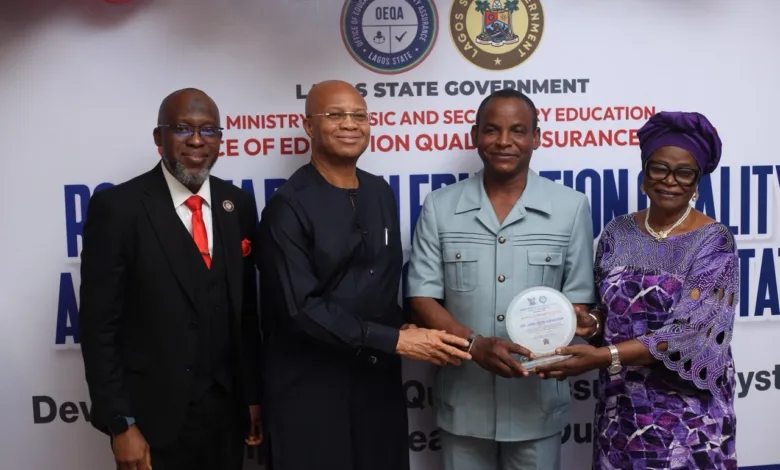
The Commissioner for Basic and Secondary Education, Jamiu Tolani Alli-Balogun, stated this at a roundtable on education quality assurance held at Protea Hotel, Ikeja. The event focused on adopting global best practices to improve learning outcomes in Lagos State.
Alli-Balogun described the theme as timely and called for stronger school evaluation, professional support, accountability and technology adoption. He also welcomed technical partners from Finland and urged stakeholders to adapt international best practices to the needs of Lagos State.



He expressed confidence that the roundtable would produce practical recommendations, measurable performance indicators and an implementation plan. Delivering the keynote lecture, the immediate past Director-General of the Budget Office of the Federation, Ben Akabueze, said education quality should be measured by children’s learning experiences rather than enrolment figures and infrastructure alone.
Akabueze noted that disparities remained in access to textbooks, science laboratories, learning resources and teacher support, particularly between public and private schools. Similarly, the Tutor-General/Permanent Secretary, Education District I, Idowu Olufunke Oyetola, called for clearer school standards, better feedback mechanisms, leadership development and certification for principals.
Oyetola also advocated improved school infrastructure, learner protection and inclusive education. She said the needs of children with disabilities should be considered in school planning and approval processes, while encouraging greater community participation in education.
The OEQA Director-General, Sulaimon Ogunmuyiwa, explained the agency’s mandate through the acronym REMI, meaning Regulate, Evaluate, Monitor and Improve. He said quality assurance should help schools identify weaknesses and improve performance rather than serve as a punitive exercise. He identified staff shortages, manual documentation, poor data management, limited professional certification and weak coordination among stakeholders as major challenges.
To address these challenges, Ogunmuyiwa proposed seven reform priorities, including training vice-principals in school-based quality assurance, introducing annual school self-evaluation plans, expanding the agency’s presence across the state’s 57 local government areas and local council development areas, and developing a Non-State School Policy. He also proposed an education quality assurance laboratory to assess learners, teachers and schools. Earlier, the Director of Planning, Research and Statistics at OEQA, Evelyn Ibukun Pelemo, described the roundtable as important to the state’s pursuit of educational excellence and global competitiveness.