A town hall in Igando-Oloja, and a chairman who opened his books for public scrutiny — by Olabode Opeseitan
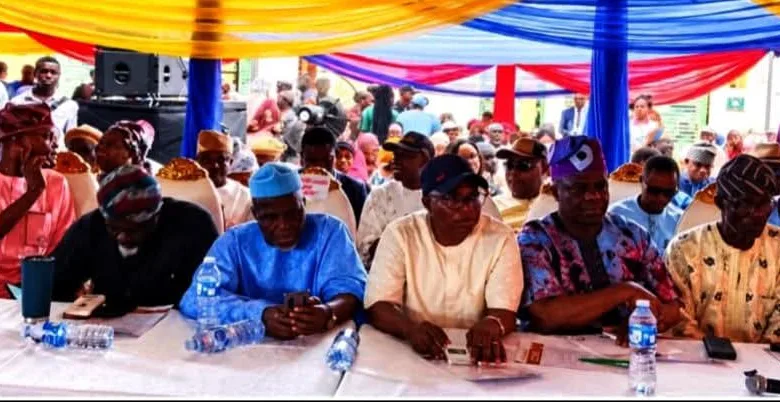
On 24th September, in a modest secretariat hall on the eastern edge of Lagos, a local government chairman did something almost unremarkable and yet, in the Nigerian context, faintly radical: he opened his books. Hon. Abdullahi Sesan Olowa, executive chairman of Ibeju-Lekki, stood before royal fathers, federal lawmakers and community associations like LERSA, and walked them through a year of delivered projects: a security intelligence network, three patrol vans, a primary healthcare centre, a career accelerator, a bursary scheme, a sixth batch of conditional cash transfers, before asking, plainly, how residents wanted the 2027 budget spent. It was governance as accounting, not campaign promise. Multiply that scene by 774, across every council area from Sokoto to Bayelsa, and you are no longer describing a town hall. You are describing a structural experiment in what Nigerian federalism was always meant to be.
The Outposts Nobody Chose
To understand why that scene is remarkable, one must understand what local government became after 1999. The 1999 Constitution’s Section 162 created a State-Local Government Joint Account, ostensibly to channel federation allocations to councils efficiently. In practice, governors treated it as a personal treasury. Caretaker committees, unelected and governor-appointed, replaced elected chairmen for years at a stretch in state after state, their leadership hand-picked by the very governors they were meant to compete with on good governance at the grassroots, collaborate with, or check if necessary. Councils were not merely underfunded; they were legally disembowelled, their revenue intercepted at source and their leadership installed by the tier of government they were constitutionally designed to balance.
The Reversal, and Its Author

That arrangement ended, on paper, on 11th July 2024, when a seven-member Supreme Court panel led by Justice Emmanuel Agim ruled the joint-account practice “an act of gross misconduct”, ordered the Accountant-General of the Federation to pay allocations directly to the 774 councils, and declared caretaker committees illegal: no elected local government, no federal allocation. President Tinubu, who brought the federal suit, called it historic and consistent with “the spirit, intent and purpose” of the Constitution . It is that ruling, not sentiment, that makes an Ibeju-Lekki budget consultative forum legally coherent rather than performative. Olowa can convene a town hall on 2027 priorities because, in theory, no governor can now quietly divert the money before it reaches him.
Lagos State itself has run such consultations at the state level for years, most recently across its five IBILE divisions ahead of the 2027 budget; what changes now is that a local council can run the same exercise on money it controls outright, rather than money a governor might withhold.
Running the Model
The scale becomes vivid once the numbers are run.
FAAC’s September 2026 disbursement allocated roughly ₦555 billion to the 774 councils combined, about ₦717 million per council monthly, or ₦8.6 billion annualised, consistent with the ₦6.5–7 trillion in aggregate annual LG allocations implied by 2026’s monthly FAAC releases. Nigerian fiscal-multiplier research finds government spending multipliers well above one, particularly in downturns, meaning every naira a council spends on healthcare, vehicles or transfers generates disproportionate activity as it recirculates locally. A conservative multiplier of 1.4 to 1.5 applied to that ₦6.5 trillion base implies close to ₦9–10 trillion in induced economic activity within a year, unlocked simply by letting existing money reach the ground rather than stall in a governor’s account.
Jobs, Counted in Wards, Not Just Aggregates
Youth employment is where the model earns its keep or exposes its limits. Roughly 23% of young Nigerians are actively seeking work, and a further 32% are out of the labour market altogether. A Career Accelerator Programme like Ibeju-Lekki’s is a rounding error nationally if confined to one council; replicated with fidelity across 774, even a modest average of 200 to 300 placements per council implies 150,000 to 230,000 new entries into work within a year, comparable to a national jobs scheme generated entirely through local administration rather than a federal programme office. The conditional cash transfers work similarly: demand-side stimulus injected at household level, precisely where fiscal leakage is lowest.
Security as a Local Government Function
The security dividend is less quantifiable but arguably more urgent. Nigeria’s insecurity, banditry, kidnapping and communal violence, is disproportionately a failure of last-mile intelligence, not national capacity. A federal or state command cannot know which compound looks wrong on a given Tuesday; a locally resourced network can. Replicated nationally, a Security Trust Fund model shifts grassroots security financing away from ad hoc vigilante funding towards transparent, budgeted local structures, the quiet infrastructure that rarely makes headlines precisely because it prevents the incidents that would.
The Caveat the Model Cannot Ignore
None of this happens automatically. More than two years after the ruling, reporting from states including Osun, Benue and Abia shows many councils still do not receive allocations directly; governors retain leverage through Directors of Finance who remain gubernatorial appointees, and through joint-project schemes that quietly reconstitute the old joint account under new language. President Tinubu himself, addressing the 774 chairmen this September, warned that “autonomy is not an end in itself” without tangible delivery . Ibeju-Lekki’s showcase is a proof of concept, not yet a national reality.
The deepest arithmetic here is institutional, not fiscal. A council that holds a budget consultative forum is rehearsing accountability at the scale where Nigerians actually experience government. Scaled across 774 councils with anything like Ibeju-Lekki’s discipline, the one-year effect would be measured less in trillions reshuffled than in a quieter shift: local government ceasing to be an outpost of the state, and becoming, for the first time in a generation, an institution citizens can call to account.