Between Reform and Reality – A measured appraisal of Tinubu’s first two years, by Adebamiwa Olugbenga
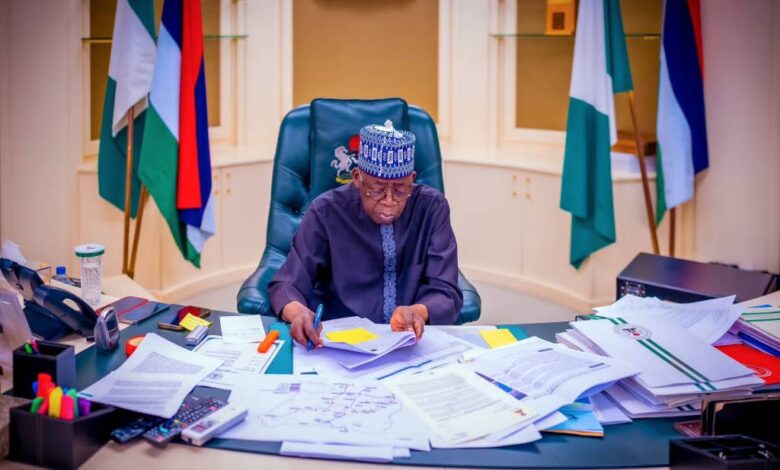
Since assuming office in May 2023 under the banner of a “Renewed Hope” agenda, President Bola Ahmed Tinubu has pursued sweeping reforms across Nigeria’s economic, security, and social sectors. Two and a half years in, the record shows both ambitious progress and sobering contradictions. This piece takes a balanced look at where the Tinubu administration has succeeded, where its reforms have strained ordinary Nigerians, and what sharper course-corrections might help sustain gains.
On paper, Tinubu’s economic pivot has been transformative. The government reports that non-oil revenue collections surged, reaching ₦20.59 trillion by August 2025 about 40.5 % higher than in 2024. In September 2025 alone, ₦3.65 trillion was collected, claimed to be 411 % higher than May 2023 levels. The removal of fuel subsidies, unification of foreign exchange rates, and elimination of “ways and means” borrowing for the central bank have been central to those gains.
A deeper assessment suggests that certain performance indicators merit cautious interpretation. Current fiscal data do not fully substantiate the reported reduction in the debt service-to-revenue ratio from 97% to below 50%. Similarly, references to gains in the tax-to-GDP ratio and export diversification remain partly supported pending more comprehensive data validation. While macroeconomic fundamentals reflect early signs of stabilization, sustained inflationary pressures and elevated living costs continue to constrain real welfare gains and the transmission of growth benefits to households.
Under Tinubu, Nigeria has posted signs of external balance restoration. In 2024 the country recorded a payments surplus of $6.83 billion driven by trade surpluses, strengthened exports, and remittances. Foreign exchange reserves climbed to over $42 billion by September 2025, a peak not seen since 2019. The World Bank reported that economic growth in 2024 was the firmest in a decade, with tight policy contributing to a more stable macro environment, even as inflation remained a drag.


These movements suggest that macroprudential discipline and external confidence have improved. Yet they also raise a pressing question, do better numbers at the top translate into relief for citizens under strain?
Tinubu’s administration has launched or revived major infrastructure projects. The Lagos–Calabar Coastal Highway, aimed at connecting the western and southeastern corridors, is underway with a 30 km section already commissioned. Rail and port redevelopment are also emphasized as critical enablers for trade and logistics.
On the power front, the situation is more mixed. While grid capacity is claimed to have expanded and abandoned projects revived, blackouts and grid collapses remain regular features, especially in 2025. (Some media reports cite over ten major collapses in that year.) Critics argue that infrastructure execution has struggled with project delays, cost overruns, and weak maintenance regimes.
In digital infrastructure, drive toward broadband expansion, digital services, and tech incubation (e.g. youth training) has gained traction. Yet the urban–rural digital divide and inadequate last-mile connectivity remain significant bottlenecks.
The administration has emphasized military offensives against Boko Haram, bandit groups, and separatist actors like ESN. The “Forest Guards” initiative introduced in 2025 is one example of a more localized security architecture. Some communities report better conditions than in prior years. Nonetheless, insecurity persists in many zones, farmers unable to cultivate, rural markets shut down and deaths from banditry and communal violence continue.
In governance, anti-corruption rhetoric has been matched with some strengthened institutions and asset recoveries. But critics argue that perceptions of selective enforcement, obscure procurements, and political patronage remain unaddressed. The suspension of democratic processes, such as in Rivers State (state of emergency imposed then lifted), also raises tensions about executive overreach.
In social policy, the administration has expanded some interventions. The National Social Investment Programme reportedly disbursed ₦330 billion to eight million households. The Nigeria Education Loan Fund (NELFUND) has been touted as helping over 500,000 students. But the flip side is that poverty remains deeply rooted. The World Bank estimates that about 139 million Nigerians live in poverty as of 2025, pointing to a serious gap between macro gains and household welfare.
In health and education, expansion of facilities and policy pilots have occurred, but concerns over quality, teacher strikes, dilapidated infrastructure, and funding shortfalls linger. The removal of certain taxes (e.g. telecom excise) and subsidies was intended to reduce burden on citizens, but the net effect is debated in light of inflationary pressures.
Several ministries have been praised for delivery, including Aviation (route expansion, airport upgrades), Works (roads, highway planning), Interior (passport and immigration process improvements), FCT (urban renewal, demolition of illegal structures), Digital Economy (broadband, youth training), and Steel (industrialization push). These align with Tinubu’s declared priorities and appear to show concrete outputs.
On the other hand, ministries like Power have been heavily criticized, frequent collapse of the grid undermines economic activity. Defence remains under scrutiny, critics contend that gains against insurgents are offset by lapses in response, coordination, and corruption. Humanitarian Affairs has been restructured following allegations of mismanagement. Ministries with soft mandates (Women’s Affairs, Labour) are criticized for low visibility, weak initiatives, and failure to engage grassroots stakeholders meaningfully.
The challenge for Tinubu’s government is that structural capacity constraints, interagency friction, and political patronage continue to limit the consistency and effectiveness of ministerial action.
Tinubu’s reforms have not been costless. Inflation peaked above 30 % before easing to about 18.02 % by September 2025, helping ease but not erase the burden on ordinary Nigerians. The volatility induced by subsidy removal, exchange rate changes, and subsidy ripple effects have strained households and small businesses.
Moreover, poverty remains widespread. Despite macro reforms, the poor continue to bear the brunt of price shocks, with many lacking buffers or safety nets. The uneven reform impact compounds regional and urban–rural inequalities. Politically, opposition forces seek to leverage economic hardship to rally against a second term. The structural nature of Nigeria’s challenges, weak institutions, dependency on oil, political fragmentation means that bold policy is necessary but not sufficient.
To build on achievements and address glaring gaps, the Tinubu administration should consider the following:
● Targeted relief and inclusion – Use digital platforms to deliver conditional cash transfers, food vouchers, or utility subsidies to vulnerable households ensuring that macro gains are felt at the grassroots.
● Security architecture reform – Beyond conventional force, invest in intelligence, community policing, judicial speed, and reintegration programs. Strengthen oversight to reduce corruption within security ranks.
● Private sector and PPP discipline – Anchor infrastructure projects in transparent public–private partnerships with delivery metrics, milestone audits, and citizen oversight to prevent slippages.
● Institutional strengthening – Bolster agencies like the EFCC, Budget Office, Auditor-General’s Office, and the Nigeria Revenue Service (which recently replaced FIRS) so that they operate with independence and consistency.
● Human capital priority – Allocate greater budget to education and health (targeting global benchmarks), enforce accountability in disbursement, and guarantee quality in underserved areas.
● Inclusive governance and accountability – Institutionalize participatory checks, town halls, independent monitoring, citizen scorecards to hold ministries accountable. Foster bipartisan commissions on long-term planning to prevent policy disruptions with each regime change.
To conclude, the Tinubu administration has laid important macro foundations and taken bold policy steps that many previous governments shied from. But the real test now is turning those structural gains into lived experiences for Nigerians. Without careful calibration, the reforms risk being remembered as top-heavy successes rather than shared progress.