Borno: Journey back to yesterday — by Bamidele Johnson
All these years, the memory lay buried somewhere beneath newer journeys, newer worries, and ordinary erosion by time. Then, on Monday evening, Chiedu Nnodi brought it all rushing back with three casual words. “University of Sari,” he wrote beneath a post I had made three years ago, adding it is a story for another day.
Immediately, I was back in old Borno State. The post itself was about Borno, where the weather can change from furnace-hot to icy torment with devilish abruptness. But “University of Sari” was our private joke. There was no such institution. The phrase came from my levity-filled mind. Yunisari is the remote settlement in the northernmost reaches of the old Borno State, now in Yobe, where the NYSC posted some of us in December 1990 to work as ad-hoc electoral staff during the local government elections of the Babangida transition programme.
That transition programme eventually collapsed into national frustration. But before it did, it sent us travelling into parts of Nigeria that felt less like destinations and more like rumours.
The NYSC authorities insisted participation was compulsory. Refusal attracted threats of severe penalties. So, corpers from my batch and the batch after ours converged on Maiduguri, Yerwa to the locals, from our various places of primary assignment. At the NYSC Secretariat on a Thursday, names were called and destinations assigned across a Borno State that was much larger then than it is today.
That was how myself, Chiedu, Kolawole Kola Bamiwuye and Arthur Abaneme ended up heading towards Yunisari.
By then, we thought we understood the North reasonably well. We had survived the fierce dry season heat and enjoyed the rains between July and September, along with the soft coolness that followed them. But older residents kept warning us about the harmattan. They spoke of it with the wary respect reserved for dangerous animals. Only Chiedu, who had attended FGC Kaduna, had previous experience of such weather. The rest of us were complete debutants in Arewa.
Then the harmattan arrived.
It came snarly, gnarly, whistling and vicious. Even in Maiduguri, it already felt hostile. But the real journey had not begun. About 150 of us, dressed in our NYSC kits and carrying modest bags stuffed with biscuits, sweaters and other things, were herded into Toyota Coaster buses headed northwards. The buses moved with agonising slowness through an increasingly sparse landscape where settlements appeared briefly and vanished again into endless earth-coloured plains. It took over six hours to get to Geidam. Night had fully descended by the time we arrived.



The moment we stepped off the buses at around 9pm, the cold attacked with sadistic tenacity. Saliva almost froze inside our mouths. Breath escaped in pale clouds. Fingers stiffened instantly. Some people folded their arms tightly against their chests as though negotiating privately with the weather.
But Geidam was merely the prologue.
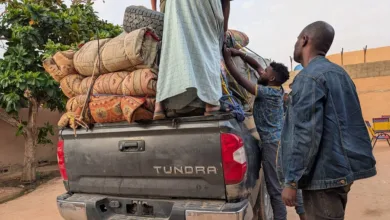
At a roadside stop with light from oil lamps and swirling dust, we bought kose and doya and washed them down with water in nylon, the equivalent of ice water tutu ree. There was no pure water. The warmth of the food offered fleeting comfort. Then came the announcement that properly dissolved morale. The rest of the journey to Yunisari and the nearby Yusufari would be done at the back of Land Rovers. That meant exposure to the full violence of the harmattan.
The terrain ahead was too sandy for ordinary vehicles. Only Land Rovers could survive it. The landscape itself looked surreal to southern eyes. Vast stretches of pale sand rose in formations resembling desert landforms from secondary school geography diagrams. Sand dunes, perhaps. I had A3 in Geography by the way, though at that moment,it academic achievement felt less useful than warm clothing.
The suffering (more appropriately sufferness) began before the vehicles even moved. Then the engines roared and the drivers accelerated furiously because slowing down meant getting trapped in the sand. The vehicles tore through the night like they were fleeing a catastrophe. The harmattan wind whipped into us with savage force, shrieking through ears and nostrils. Boys and girls crouched low. Teeth chattered violently. Faces disappeared inside collars and sleeves.
Then people began vomiting.
At first it happened sporadically. Soon it spread from vehicle to vehicle. Those who considered themselves strong merely prolonged the inevitable. They retched for a while before surrendering completely to the combined assault of cold, speed and exhaustion. Oluwaseyi Oduyela, who was in the batch after mine, fell ill. Then came the plants.
Scattered across the barren landscape were hard drought-resistant shrubs with branches stretching directly into the paths of the speeding vehicles. Passengers ducked instantly whenever they appeared. We even found some fun, as we would shout “take dressing” whenever a branch hoved into view. The drivers, safely enclosed inside the cabins, had no such worries. Travelling at night made things worse. Many people did not see the branches until too late. They were slashed across faces, necks and arms. One fellow seated beside me suddenly stood up for reasons best known to only himself. A branch caught him almost immediately and tore into his skin. Blood flowed.
I knew I had to behave myself and not do anyhow if I did not want to see anyhow. I reached into my small bag, pulled out a towel and wrapped it around my head Bedouin-style. We travelled through the night like that.
By morning, the Land Rovers began dropping us off one after another in isolated settlements spread across that immense dry landscape. I remember staring at some of those villages in disbelief. I genuinely did not imagine human beings could inhabit places so remote, so stripped down and so unforgiving.
Yet they did and perhaps still do, if Boko Haram has not wiped them.
I no longer remember the exact name of the village where I was posted. But I remember arriving there with one Ben Worika, a fellow corper from the University of Port Harcourt. It my first and only time of meeting him, but we hit it off immediately. He liked Michael Franks, a singer I idolise. We lodged in the residence of the traditional ruler.
His compound was made of thatch. The man had two wives. By then I had begun picking up bits of Hausa and a little Kanuri. I called the man kwaferaye, the Kanuri word for oko iyawo. The ruler and his wives spoke no English, but they were warm people with easy smiles. It would require intoxicated optimism to expect them to speak English. One of the wives stared at us continuously with the fascinated concentration of a reality show judge examining eccentric contestants.
The village itself fascinated me.
Nobody sold anything.
I wanted chewing gum. Babu.
I wanted Coke. Babu.
Nobody sold nothing because the community functioned almost entirely on self-sufficiency. The food served to us was rice and beans soaked in mai shanu, oil derived from cow fat. There was no stew. No seasoning. The food tasted so unsalted as though we were rastas. The water served alongside it was brownish.
Worika, who studied Microbiology, examined it and quietly advised me to request boiled water instead.
I conveyed the request in Hausa.
One of the wives immediately went to boil it. Her husband arrived just as she was bringing the water to us and asked in Kanuri what it was for. When she explained that we wanted boiled water for drinking, the chief exploded in amusement. “Wayooo Bature!” he shouted. We were behaving like Europeans.
But we had little choice.
That rice remained our only proper meal throughout the stay. Fortunately, we had travelled with biscuits and depended heavily on them, though still washed down with suspicious-looking water. Then election day arrived. The electoral officer eventually brought the materials. Voting in those days involved queuing openly behind posters of preferred candidates. The entire process finished astonishingly quickly.
Nine voters queued behind the SDP candidate.
Two queued behind the NRC candidate.
That was the election.
Soon afterwards, we climbed back into the Land Rovers and began retracing our route through sand, cold, darkness and the unforgettable harmattan of the so-called University of Sari.