Fake news constitutes institutional burden on Nigeria’s public service, says Olaopa
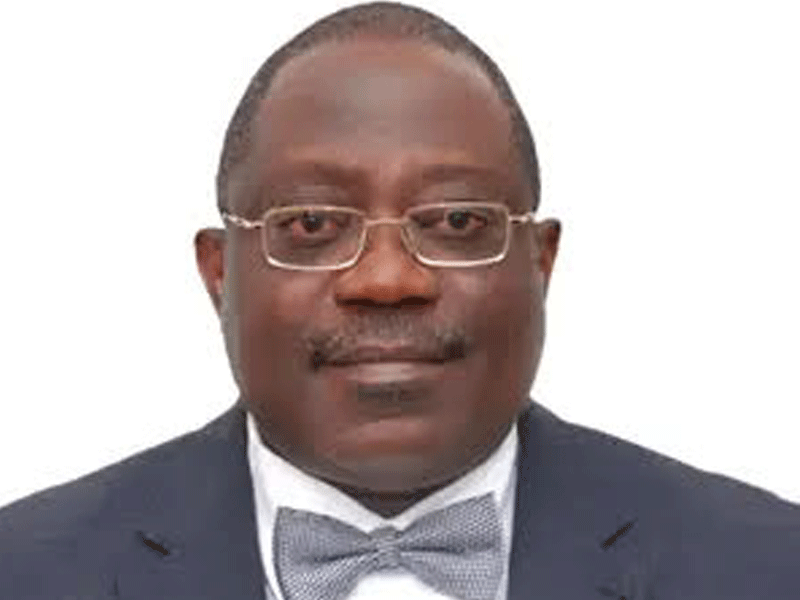
Chairman of the Federal Civil Service Commission (FCSC), Prof. Tunji Olaopa, has said the fake news ecosystem constitutes another layer of institutional burden that aggravates the predicament of public administration in postcolonial Nigeria.
Olaopa who made this assertion in his paper tittled “Disinformation as Threat to the Civil Service Function in Post-Truth World”, said that when disinformation and misinformation spread, they serve as the vectors of the ineffectiveness of the public service.
He added that fake news has become a vicious circle in the sense that the digital and media technologies and the new media further compromises the bureaucracy’s participation in the entrenchment of underdevelopment in Nigeria.




The Professor of Public Administration explained that ” Disinformation erodes the capacity of Nigerians to relate with the bureaucracy as an apparatus that is unbiased and efficient.
“The social media has now provided a space for the explosion of disaffection against the public service. And this constitutes the hotbed for sowing misinformation and disinformation that further undermines whatever reform gains the civil service might be enjoying.
” One way to see this, within the Nigerian context, is to connect the non-optimal performance of the bureaucracy with the spread of misinformation, for example.This is significant because the bureaucracy is the focal point of government’s governance and policy frameworks upon which the well-being of Nigerians is grounded.
“In Nigeria, and for over six decades, Nigeria has been struggling with national integration that is conditioned by a lack of development strategy that would have unite Nigerians around infrastructural development and the Nigeria Project”.
” Given that Nigeria is heterogeneous and politically combustible, the political intrigues and shenanigans plays on the dynamics of fake news ecosystem to undermine the government of the day, its public service apparatuses and its governance architecture”.