The Northwest comeback: Inside Tinubu’s push for peace, prosperity and progress — by Uche Nnadozie
For decades, Nigeria’s North-West was defined by insecurity, poverty, abandoned infrastructure, unemployment and political neglect. Roads collapsed. Rail projects stalled. Rural communities became isolated. Farmers lost access to markets. Investors stayed away.
Today, however, a different story is emerging across Sokoto, Kaduna, Kano, Katsina, Jigawa, Kebbi and Zamfara. Highways are reconnecting communities, rail projects are reviving trade corridors, hospitals and housing estates are rising, while agricultural and rural access roads are opening up economic opportunities.
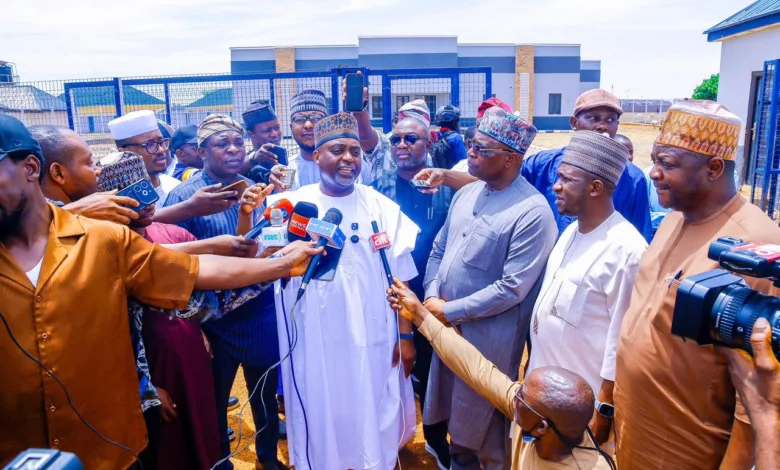
The recent inspection tour by the Presidential Media Team and the Renewed Hope Ambassadors across the North-West offered a closer look at the scale of projects underway under President Bola Ahmed Tinubu’s administration.
What the delegation encountered was visible infrastructure: roads, bridges, hospitals, rail lines, housing projects, skill acquisition centres, solar-powered streetlights and expanding economic corridors.
As President Tinubu approaches three years in office, the North-West is increasingly becoming a major test case for the Renewed Hope Agenda’s emphasis on infrastructure, economic revival and national integration.
Sokoto–Badagry Super Highway
One of the administration’s flagship projects is the Sokoto–Badagry Super Highway, a long-conceived national corridor now advancing after decades of failed promises.
Stretching about 1,068 kilometres, the highway is designed to improve connectivity between Northern and Southern Nigeria while opening up agricultural and commercial routes.
In Kebbi State alone, about 258 kilometres pass through major farming communities, potentially improving the movement of rice, tomatoes and other agricultural produce to larger markets.
The project also incorporates concrete pavement technology, solar-powered lighting and embedded rail infrastructure, reflecting a longer-term infrastructure strategy.
According to Kebbi State Deputy Governor Umar Abubakar Tafida, the project demonstrates a broader national integration vision linking regions through trade and transportation infrastructure.
Kaduna and inclusive development
Kaduna State has emerged as another focal point of infrastructure and social investment.
Projects inspected included the 35-kilometre Gadan-Gayam, Gwaraji and Kujama road network connecting dozens of farming communities to markets and social services.
The Bola Ahmed Tinubu Specialist Hospital, a 300-bed facility, is expected to strengthen healthcare delivery in the state, while the multi-billion-naira Skills Acquisition Centre targets youth empowerment and vocational development.
Work has also resumed on the 21-kilometre Kaduna Western Bypass, a project abandoned for more than two decades before being revived under the current administration.
In Tudun Biri, following the tragic military drone incident, federal and state interventions have focused on rebuilding homes, roads, healthcare facilities and public infrastructure.
The resettlement programme also deliberately promoted interfaith coexistence, with Muslims and Christians resettled side by side and both a mosque and church rebuilt within the community.
Rail infrastructure and regional trade
Rail development remains central to the administration’s North-West strategy.
The Kaduna–Kano–Jigawa–Katsina–Maradi rail corridor is progressing steadily and is expected to reconnect major commercial and agricultural centres across the region.
The 203-kilometre Kaduna–Kano segment is expected to improve the movement of passengers and goods while reducing pressure on road transport.
Similarly, the Kano–Maradi standard gauge rail line linking Nigeria to neighbouring Niger Republic is projected to strengthen regional trade and position Northern Nigeria as a commercial hub within West Africa.
Kano is also being positioned as a future rail convergence centre, while Kaduna State is advancing plans for a light rail system aimed at improving urban mobility.
Complementing these projects is the Abuja–Kaduna–Zaria–Kano Expressway, a 375-kilometre dual carriageway currently under construction.
Expanding road networks
Beyond flagship projects, road rehabilitation and expansion efforts are ongoing across the North-West.
The Kano–Katsina dual carriageway is improving interstate movement and trade, while rehabilitation of the Marabar Kankara–Dutsinma–Katsina Road is restoring access to previously neglected communities.
Other planned and ongoing corridors include the Zaria–Hunkuyi–Dabai–Kafur–Malumfashi–Dayi–Gidan Mutum Daya route and sections of the Kano–Maiduguri dual carriageway.
Together, these projects are aimed at improving mobility, supporting agriculture and strengthening regional economic integration.
Development and economic stability
The administration argues that recent economic reforms, including fuel subsidy removal, have increased fiscal capacity for states to fund infrastructure and social investments.
Across the North-West, governments are channeling resources into roads, healthcare, housing and rural development.
Supporters of the reforms argue that improving infrastructure and economic opportunities is critical to long-term peace and security, particularly in regions affected by unemployment and instability.
Healthcare and human capital
Healthcare and education investments also form part of the broader development strategy.
Upgrades are ongoing in more than 1,000 primary healthcare centres across Northern Nigeria, while projects at the Aminu Kano Teaching Hospital and Ahmadu Bello University Teaching Hospital are expanding tertiary healthcare capacity.
The Katsina State Agricultural Mechanisation Centre also reflects efforts to modernise agriculture and improve food production through technology and skills development.
The politics of performance
As political debate intensifies ahead of future elections, infrastructure projects are likely to remain central to public assessment of governance.
Supporters of the administration point to roads, hospitals, rail projects and housing developments as evidence of measurable progress across the North-West.
Challenges remain, including insecurity, poverty and economic hardship, but the administration maintains that ongoing interventions reflect a broader attempt to rebuild economic confidence and regional stability.
Across Sokoto, Kaduna, Kano, Katsina, Jigawa, Kebbi and Zamfara, the North-West is gradually witnessing renewed investments in infrastructure, agriculture, healthcare and transportation.
For many residents, the significance lies not only in the projects themselves but in the growing sense that long-neglected communities are once again being connected to national development.
- Nnadozie a development communication specialist writes from Lagos