Lagos, public transportation and her impatient driver — by Bamidele Johnson
I do not know if the Lagos I came to in the early 90s still exists. Things have changed, drastically. But I suspect that in certain corners, the more things change, the more they remain the same. That is a suspicion, not knowledge.
I grew up in Ibadan, a city that sits at the opposite end of the temperament scale from Lagos. In Ibadan, at least before I left, a taxi driver who spotted you coming would slow down and wait, while a bus conductor (kondor in local parlance) would holler at you from 100 metres. There was a certain unhurried civility to getting around. Nobody in Ibadan seemed to believe that arriving at a destination was worth your blood.
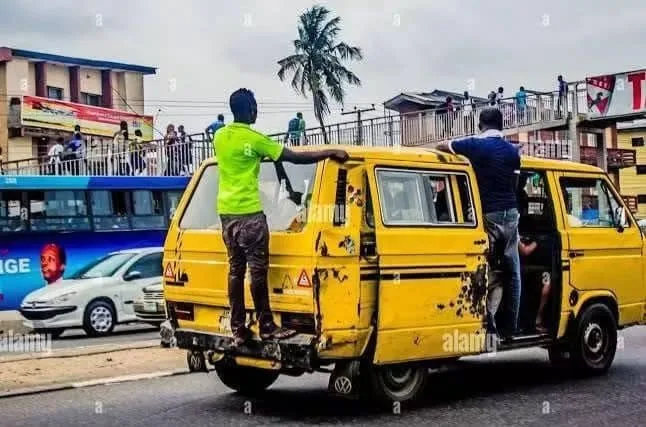
Lagos held the opposite view. Its buses hardly stopped at all, so you hopped on while the conductor yelled, “Pa pa pa!” and warned, “Wole pelu change e ni o!” Getting off demanded the same athleticism in reverse. Even if your luggage (load, it is called) was sitting in the boot, the bus kept rolling while the conductor, a man accustomed to perpetual motion, flung it onto the tarmac and leapt back onto the speeding vehicle with the nimbleness of a pole dancer.
There was no time for sentiment. The bus had a schedule to keep. “Gbori e”, “Gbe won rin” would follow.
The Lagos I encountered was a city that treated public transportation as an endurance test on wheels. You did not just board a bus. You demonstrated that you deserved to be transported. You did not just disembark. You negotiated a temporary suspension of the laws of motion and hoped the ground would be kind when you met it.




The molue, which I no longer see, was a different beast altogether. In look as well as feel, it was inhospitable. Mightily so. It was a rusting, roaring hulk that regarded the passenger as an inconvenience to be tolerated at speed. At rush hour, boarding could involve a duel with countless desperate bodies and the fittest might have to enter through the window. Sometimes, the best that victory earned you was the privilege of standing for the entire journey. For that duration, your face got pressed into a stranger’s armpit and your mouth might be brushing against an eczema-spangled neck, while your ears got assaulted by hawkers bawling “tanmana, kuruna, lakuegbe”.
There were no personal-space issues because personal space did not exist. The concept, I suspect, had been declared illegal somewhere between Agege and Oshodi. You were packed so tightly against fellow passengers that you could tell what they had eaten, what soap they used and, in some cases, what they had been thinking about. You might not know their names, but you knew them intimately enough to be uncomfortable about it.
Standing could be specially unpleasant for women. There were the sickos who took advantage of the crush to push into women. They did not do this in the unavoidable, packed-like-sardines way that went with the territory, but in a deliberate, push-the-pelvis-directly-on-purpose-into-butt-cheeks kinda way. In the molue, the architecture of public transport offered cover to private depravity.
Getting off demanded a separate skill set from getting on because the vehicle never truly stopped. You were expected to launch yourself off it at a speed that would trouble a sprinter. The dexterous leapt, kept running and decelerated by degrees until balance returned like a plane taxiing out of a landing. Those seduced into jumping without the requisite skill landed, stopped dead and fell spectacularly, their dignity splashed across the asphalt to loud choruses of “Haaaa”, “Yeepa”. I doubt we had the now famous “Ehya” at the time. Sometimes, a fall provided entertainment for other passengers.
It was not the business of the conductor to ask if they were all right. His business was to ensure they had successfully disembarked. In Lagos, survival and successful disembarkation were practically the same thing. I sometimes wonder what happened to that Lagos.
The molue seems to have disappeared from the roads and the city has acquired new buses, newer roads, better transport systems and an altogether different urban landscape. But has the temperament changed? Has the city learnt to be patient or has it merely found newer, more efficient ways to be impatient? Do passengers still have to fight their way into vehicles? Do conductors still treat human beings as cargo that must be loaded and discharged with minimum disruption to the movement of the vehicle?
I suspect that the old Lagos survives in places, perhaps in the conduct of its drivers, in the impatience of its commuters and in the peculiar determination of people who understand that if they wait for the world to make room for them, they may never get anywhere. But suspicion is not knowledge, and nostalgia is a notoriously unreliable witness. Memory can make a terrible experience seem almost charming simply because the years have passed and the bruises have healed.
Still, I remember the molue. I remember the danfo, the conductors with armpits that fizz with grime and sweat, the desperate leaps and the spectacular falls. I remember the sheer physicality of getting from one part of Lagos to another, as though commuting were a contact sport for no protective equipment was provided.