Malagi: Between public trust and media power, by Saidu Ahmed
“We must keep on fighting to show people every version of what’s happening, the broad spectrum of facts, so that they can make up their minds.”
-Deborah Turness, CEO, BBC News
It will be an exigent requisition for a popular strategy that will guide public communication if truly we all believe earning public trust in an evolving democracy comes with a burden of legitimacy. In an age where humanity still struggle in order to search for meaning and truth within the complex premises of news and information broadcast, public communication has to be brought out from the dust of contradictions and disinformation. One must demonstrate a high-level of moral gumption and outstanding social esteem before he/she scale through the polygonal hassle of communicating government policies and simultaneously earning the confidence of the people. However, i have often argued that even political power assume what it is because communication took place between conscience and teleology whom are both distinctive embodiment of human virtue.
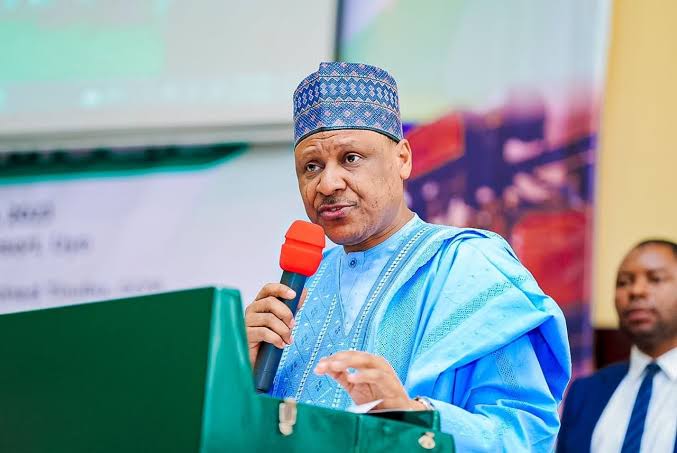
A layman will be curious to know, what exactly is the job of a chief spokesperson of the government? Is it to speak for the government alone or he is at the same time chief spokesperson of democracy? Can you speak for the government at the same time speak for the people? Should we now moralize the role of civil society as the focal institution responsible for maintaining public trust in a political system and elevate the status of the political class as caretakers of national interest? The feasibility of maintaining a balance between public trust and media power which is rather an inherited political influence a chief spokesperson enjoyed will now depend on his ability to see national interest as a moral aspiration guided by divine prescription.
A society cannot achieve the highest level of happiness as a democratic republic or as a sustainable political economy if it cannot earn the trust of it’s public information dissemination system wether as a government or a civil society. Section 22 of the 1999 Constitution mandates that the press must hold the government accountable to the people. But who now holds the press accountable? may be the conscience of the people?
Herbert Spencer like other classical thinkers Hans Kelsen, Alfred Marshall and David Ricardo, believe “Every man is free to do that which he wills, provided he infringes not the equal freedom of any other man”. This principle emphasizes that individual liberty is limited by the equal liberty of others. In an age where political participation is gradually moving to the zenith, the metier of Information Minister will continue to be challenged by the substance of a shifting reality; between public trust and media power.
In public communication one must take the risk in cultivating a sense of identity, purpose and long-range intention. I’m not using the Minister of Information as an alchemist that can turn every stone (problem) into gold (solution), but the Minister as a democrat has aligned his mandate with the believe that, we are a constitutional and multi-party democracy that was forged by a structural political pressure constantly seeking for the immediate realization of an ideal society, and which can only be achieved through a legitimate resistance on the forces of disinformation and the implicit errors of groupthink.
I stand here with Paul Collier (Professor of Economics & Public Policy at the Blavatnik School of Government) and John Kay (founding head of Said Business School, Oxford University) that, a successful society needs to inculcate a sense of shared belonging to articulate a casual chain from common sacrifice and shared values to a better future, and to define criteria for bestowing good opinion on other members of the group. That package creates social pressure to comply with group obligations, and guides people how to judge themselves. This shares a common ideological ground with what the CEO of BBC News as quoted in the beginning of this article.
Each of these, the common identity, the shared purpose, the bestowal of approval requires communication and persuasion. A community is a network of communication, but Individually we can only know a limited number if people; only in small groups can everyone communicate with everyone else.
As our purpose has become more ambitious, we have needed to cooperate in larger groups, and for this we need super-communicators, politician, business executives, religious leaders and journalists, who do communicate with everyone. More subtly, we all need to know that these communicators are talking to all of us. This turns the message into common knowledge: we all know that we all know the same things. Such large and complex societies become multilayered, networks of networks. They have the potential for the cooperation that shelters from storms, while nurturing the competitive creativity of progress.
I want to conclude philosophically here that, building public trust is not the task of the chief spokesperson alone and the exercise of media power by him is not to alienate the ground norm of a sovereign democracy that gives the people the right to hold government accountable for their actions. The media is a liberal landscape that supposed provide the civil society the oxygen to remain alive, so if we look deeply, even the onus to guarantee press freedom which we traditionally believe it’s only the government that can exercise those powers, is an ontological aberration of the principles of democracy.
–Ahmed is Special Assistant, Research and Strategy to the Minister of Information and National Orientation