Our (Nigerian) leaders, by Folabi Ogunleye
A favorite whipping boy of Nigerians, for all that ails Nigeria, is captured in the phrase ‘our leaders.’
‘Our leaders is the problem,’ too many of us love to say of those few men and women among us who make it to positions of leadership in our country.
This they say, as if these leaders do not come from the same social genepool, where the rest of us exhibit very similar orientation as our leaders.
The average Nigerian, whether poor or rich, is as impatient as he is brash, and is often dismissive of others in the way of his purpose or point of view.


Give a typical Nigerian access to little power, and he becomes a little tyrant who uses the power to intimidate others and have his way over others.
A Nigerian will gladly welcome the power to jump the queue and circumvent the law. He employs soldiers to bully others to accept his preferences.
And when another Nigerian dares to confront the Nigerian who misuses his privilege to violate the law, the latter will do everything to browbeat the former.
A Nigerian in violation of the law may not even show up to defend himself. Instead he might simply find some lower-ranking conscripts to defend his illegality in his absence.
And then follows the usual drama.
Of course the rest of the citizens who have always blamed the leaders for all that is wrong with Nigeria will show up to do what they do best.
They will hardly investigate the situation or wait for a full account of the episode to come forward for proper context before taking sides in the matter.
Lost on these Nigerians is the irony of their position, where they are found defending the very problem that they so often condemn in their leaders.
We Nigerians love to fantasize about the need for civility, order and probity in our polity. But we hardly measure up when it comes to living by the standard.
And then we complain about ‘our leaders,’ forgetting that our leadership at any time ‘t’ is a reflection of who we are as peoples of Nigeria.
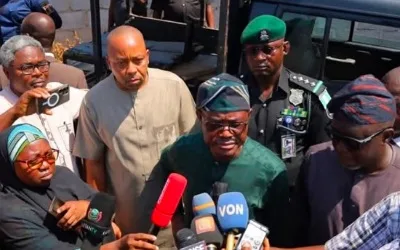
Nyesom Wike was doing his job as chief administrative officer of the Federal Capital Territory when he chose to visit the location of that altercation between him and the naval officer.
The visit followed negative reports that reached him, alleging that officials of his administration were not allowed to do their job on the property, which supposedly belongs to a retired naval chief.
And Wike, being the Nigerian that he is, was brash, impatient and dismissive of the young officer in the path of his purpose and objective at that location, insulting the latter during the encounter.
The typical Nigerian, especially one like Omoyele Sowore, alias ‘national youth,’ would have acted just like Wike did in that moment. Whether we are in the right or wrong, we are usually confrontational.
It is arguable that Mr. Wike should have engaged that soldier with civility. But too few among us practice what we preach. In fact, a Wike approach comes highly recommended in managing our excesses.
It probably explains why, when Dr. Reuben Abati of Arise TV asked President Tinubu how come Mr. Wike remained in place after a recent cabinet reshuffle, the president expressed confidence in Wike.
And indeed Wike has been quite successful in his role as the FCT minister, besting every one of his predecessors in that role after only two years at the helms.
As that notorious entertainer sang at the Olubadan’s installation ceremony a few weeks ago, ‘Wèrè ni a fi ń wo wèrè.’ In other words, ‘Na madness dem dey take treat madness.’
On to the next drama.