Renewed Hope tour of the North‑West: A harvest of presidential investments — by Babajide Fadoju
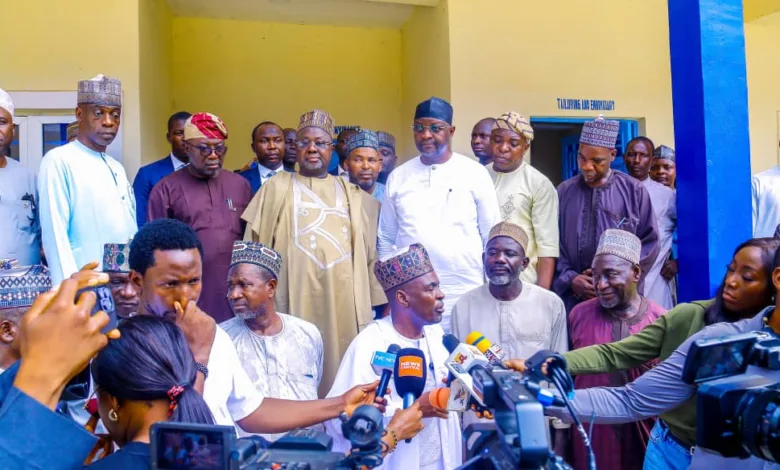
The Renewed Hope Tour of the North‑West has come and gone, but it has left behind a clear, verifiable record of what focused federal investment can achieve. Over several days, the inspection team moved through Kaduna, Kano, Jigawa, and beyond, documenting projects that span road and rail infrastructure, agricultural mechanization, healthcare, education, environmental management, and community reconstruction.
What became immediately evident is that the increased fiscal allocations made possible by President Tinubu’s bold decision on fuel subsidy removal have empowered states to execute long‑stalled projects while the federal government concurrently delivers flagship rail and highway corridors.
The tour was not a photo opportunity; it was a calibrated, evidence‑led evaluation of the Renewed Hope Agenda in action.
Transportation and Rail: Weaving a New Regional Grid
The most visible gains were in transport. On the Abuja–Kaduna–Kano highway, a 775‑kilometre federal artery, sections that were once death traps have been rehabilitated, with the contractor Infiouest reporting that the Zaria–Kano leg is over 95% complete and the entire highway on course for completion by November 2026.
In Kano, the multi‑layer flyover at the notorious Tal’udu junction is ready to resolve decades of congestion. But the crown jewel is the Kano–Maradi standard‑gauge railway, now at 60% completion, with on‑site pre‑cast yards producing sleepers and flyovers rising alongside the tracks.
A 109‑kilometre branch line to Dutse, Jigawa State, will soon bring rail connectivity to the state capital for the first time. These projects, when finished, will link the agricultural north to the ports of Lagos, while also connecting Nigeria to Niger Republic, boosting regional trade and reducing the burden on road networks.
Agriculture and Rural Empowerment: Tractors, Dams, and Skills
Jigawa State emerged as a laboratory for agricultural transformation. The Jigawa Farm Mechanization Service Company, fully solar‑powered, has deployed 300 tractors, 80 boom sprayers, 60 combined harvesters, and 150 rice seeders across 60 service centres, each staffed by locally trained technicians given permanent appointments.
The tour also inspected the Kafin Chiri Dam in Kano South, a 1978 structure abandoned for decades, now being rehabilitated with a 9.47‑kilometre primary canal, a 7.1‑kilometre secondary canal, and 2.75 kilometres of field canals.
Alongside, 6,000 tube wells are being drilled across 16 local government areas. These are not ceremonial launches; farmers are already returning to their lands, with year‑round irrigation expected to transform food security and rural employment.
Healthcare, Education, and Environmental Intervention
The social sector recorded equally striking achievements. In Kano, the Hasiya Bayero Paediatric Hospital, once neglected, now offers free child healthcare, including drugs and laboratory tests, after two phases of renovation.
The colonial‑era Muhammad Abdullahi Wase Specialist Hospital is undergoing a ₦1 billion upgrade. In education, Kano State has allocated over ₦430 billion (2026 budget) to the sector, recruited 18,000 teachers, and sponsors 183,000 students annually for NECO, JAMB, and NABTEB.
The tour also highlighted an ecological intervention that is rarely seen at this scale: the 6.7‑kilometre Jakara–Kwarin Gogau–Zungeru drainage corridor, approved by President Tinubu from ecological funds (₦47 billion), will finally end decades of open waste channels, malaria, and flooding in Kano metropolis. And in Tudun Biri, Kaduna, a community tragically struck by a drone misfire, the federal government built 134 housing units, the state built roads, a clinic, and a skill acquisition centre, and even a church and mosque were rebuilt side by side to symbolise unity.
The Overarching Verdict: Continuity, Quality, and No Region Left Behind
Perhaps the most important takeaway from the tour is that continuity has replaced abandonment. On every site visited – from the pre‑cast sleeper yards on the Kano–Maradi rail line to the newly tarred streets of Dutse, from the solar‑powered technical workshops of Jigawa to the flyover piers of Kazaure – work is proceeding concurrently, not sequentially.
Quality control is enforced through on‑site casting, real‑time monitoring, and independent testing. Security challenges and mining licence disputes along the rail alignment have been managed without losing momentum.
The East‑North transport hub is on course to join the western region in full connectivity.
The Renewed Hope Tour of the North‑West has now concluded, but the message it delivered is lasting: under President Bola Ahmed Tinubu, federal investment is visible, verifiable, and designed to leave no community behind.