The Udara tree in Igbo cosmology, by Kelechi Deca
Whenever I think about the economics of culture and traditions, against the backdrop of the extent it shapes values and our belief systems, I am always amazed at the depth of such intellectual interrogations.
The deeper you go, the deeper it gets.
Over three decades ago, I took cognisance of the fact that most of the Udara trees my generation know were planted by people we never met, either our grandnothers, grandfathers or greatgrandmothers and their generation.
The Udara tree is a tree with great spiritual, cultural and ecological symbols for the Igbo. The tree’s deep roots and expansive canopy symbolize connection—linking the underworld (roots), the earthly plane (trunk), and the heavens (branches). This reflects the Igbo cosmic view of interconnected realms.




As a tree with a very long lifespan, “ownership” is always transgenerational, but in the true sense, and in line with Igbo Cosmology, Udara is not owned by anybody even though someone planted it. Every Udara is “Udara Oha” due to its spiritual significance in the life of the community.
But changing economic situation has changed this throughout Igboland. Transforming Udara from a communal tree to an economic tree that can be plucked and sold. I heard that some people now sell an entire tree for traders to pluck and sell the fruits.
Such was unheard of in the days of our grabdfathers and fathers because Udara is not an ordinary tree. It holds rich spiritual and cultural symbolism in Igboland, and these are deeply rooted in both traditional religion and everyday life.
The significance of the Udara tree in Igboland transcends its nutritional and medicinal value, it has nothing to do with its “Nwannuness or not”. It touches on some of the deepest essence of our themes of life, spirituality, community, and the cosmos. Udara represents life.
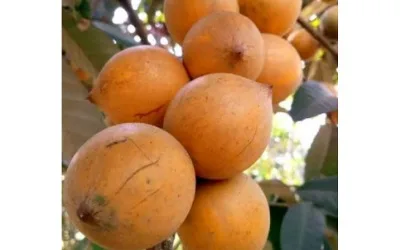
It is a daily representation and constant reminder of the ubiquity of the Ala ( Earth Goddess) which is the preeminent amongst the pantheon of gods in Igboland. Udara symbolises life, fertility and abundance. That is why we refer to it as Udara Ọmụmụ.
Women who were considered barren always visit the Udara tree when there’s no one in sight praying to be blessed by the Goddess of the Earth who overseas fertility.
A ripe Udara falling down for such women are considered signs of answered prayers. My grandfather planted one Infront of our compound and my Mother had more than enough.
It is a symbol of the constant assurance of life. It is one of the few trees that defies the seasons with its leaves lushy and lively all year round.It retains its leaves year-round, symbolizing life, resilience, and continuity. This connects it to the cyclical nature of life and the enduring presence of the ancestors.
Its fruits which are always more than enough for everyone highlights fruitfulness and symbolize prosperity, fertility, and divine provision. That is why it is regarded as a gift from Ala (the Earth Goddess), who governs fertility, morality, and the land.
It was also a special treat for young lovers as young men used to go distances to pick the sweetest Udara fruits for their bethroted or young wives.
Growing up, I heard different stories connecting the Udara tree with the spiritual, especially the deities linked with fertility, childbirth and children. It is considered a dwelling place for spirits and a gateway between the physical and spiritual realms.
That’s why many of the communal Udara trees were located close to shrines. And it was forbidden to fight under the Udara tree, throw stones at the fruits or pluck it.
In my place it was a taboo to throw sticks or stones at Udara fruits because forcing it to fall is against the laws of nature and the land. Udara fruit falls for whom it desires to fall for thus must never be forced.
Also being a sacred tree, there must be unassailable reasons before it is cut down because the Igbo believes that both humans and spirits take refuge under the Udara tree, thus considered sacrilegious to cut down the tree without deep considerations.
In most parts of Igboland, under the Udara tree is sacred as the tree is regarded as righteous, steadfast, an epitome of integrity and a symbol of truth and justice, that is why years ago, people who engage in oath-swearing and dispute resolution do so at the foot of the Udara tree.
Because of the above, it is also regarded as a protective spiritual barrier similar to Bitterkola tree. Our ancestors believed that as a symbol of truth and justice, it has enough positive energy to ward off evil spirits.
As I earlier mentioned, economics, Christianity and modernisation has changed almost everything.