Tinubu’s flourishing stats still not touching cost of living — by Yemi Adebowale
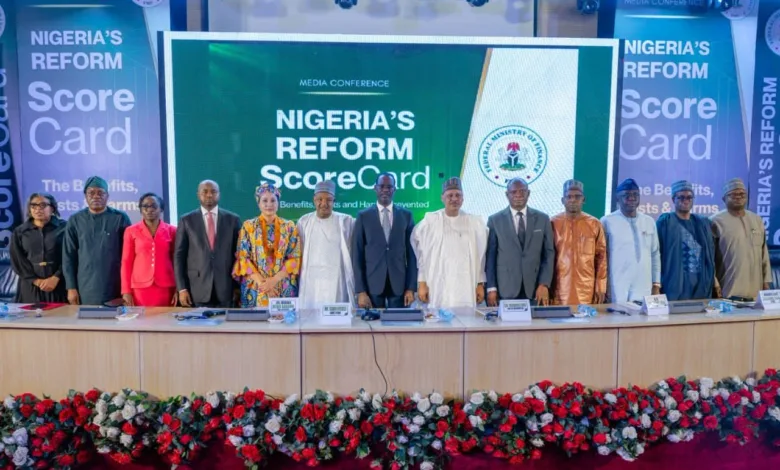
Last Wednesday in Abuja, the Finance Minister/Coordinating Minister of the Economy, Taiwo Oyedele, spent hours lecturing Nigerians on the positives from the over three years of sweeping economic reforms by the Tinubu government. It was during the presentation of President Tinubu’s “Reform Scorecard: The Benefits, Costs and Harm Prevented.” As usual, the flourish stats poured. The biggest was that the removal of petrol subsidy and the unification of the foreign exchange market generated N15.8 trillion in additional resources for the Federation between June 2023 and December 2025. Gorgeous.
Before the gains revealed yesterday by Oyedele, Tinubu, his ministers and other aides often unleash stats on the gains of the reform on hapless Nigerians as if they were all that are needed to reduce the hunger in our land. On cash to states, they frequently tell us that under Tinubu, state allocations have more than doubled compared to the Buhari years. The stats are impressive. Figures from the RMAFC indicate that allocations to Nigerian states have surged significantly by over130%, largely driven by economic adjustments like the removal of the petrol subsidy and the floating of the Naira.
Last month, Governor of the Central Bank of Nigeria, Yemi Cardoso, announced that Nigeria’s foreign exchange reserves was now $52.52 billion. “This is sufficient to finance approximately 11 months of imports of goods and services, surpassing the international benchmark of three months cover,” he joyfully declared. He also said that real Gross Domestic Product (GDP) expanded by 3.89 per cent in the first quarter of 2026.
The latest figures contained in the Consumer Price Index report released by the National Bureau of Statistics last Monday, showed that Nigeria’s headline inflation rate fell to 15.43% in July 2026, representing a 0.48 percentage-point decline from the 15.91% recorded in June. According to the NBS, the July inflation rate also marked a sharp decline from the 24.94% recorded in July 2025, indicating a 9.51 percentage-point reduction year-on-year. Fantastic.

Statistics on investments by foreigners are also attractive. Nigeria emerged as one of Africa’s strongest foreign investment performers in 2025, recording a 148% increase in Foreign Direct Investment (FDI) inflows despite a sharp decline across the continent, according to the UN Trade and Development (UNCTAD) World Investment Report 2026. Nigeria stood out as one of the continent’s best performers, with FDI inflows rising from $1.61 billion in 2024 to $4.01 billion in 2025. The increase placed Nigeria among Africa’s leading investment destinations.
By the way, Nigeria’s lovely stats on FDI were driven largely by major transactions in the oil, gas and energy sectors, rather than broad-based investments in manufacturing and other productive sectors. I will come back to this on another day.
Lovely statistics, no doubt, from and for the Tinubu government. Unfortunately, they are yet to start putting foods on the tables of most Nigerians. Positive statistics alone can’t tackle hunger. Much more are required. So, many homes and businesses are still in anguish. Tinubu’s defense is that reforms take time to positively-impact on the people. But after three years and three months, his reforms are still largely negatively-affecting the masses of this country. It is looking as if it would take eternity to have a positive impact. I hope it would not.
The condition of the masses of the people is looking hopeless. In these Tinubu years, the cost of living has been skyrocketing – cost of food, electricity, healthcare, school fees, transportation, housing, petrol, diesel, kerosene, and the rest. The masses are gasping for breath. Many go to bed without meals and wake up not sure of breakfast. What a country.
The recent World Bank’s “Country Partnership Framework for Nigeria” captures the struggle of Nigerians living under the Tinubu reforms. After over three years of extensive economic reforms, about 79 per cent of Nigerians remain poor or vulnerable to falling into poverty, highlighting the country’s deepening social and economic challenges, reports the World Bank.
According to the document, “33% of its population is ultra-poor, 61% is below the poverty line, and 79% is near poor i.e., below the poverty line or vulnerable to falling back into poverty.” It indicated further that while recent macroeconomic reforms had helped to stabilise the economy and restore investor confidence, however, “the benefits have yet to translate into meaningful improvements in living standards for most Nigerians.”
The World Bank reviewed reforms introduced by the Tinubu administration, and said they had begun to improve macroeconomic indicators. However, it warned that high inflation continues to undermine household incomes: “High inflation, though declining, continues to erode real incomes, particularly for the poor. Social protection efforts to support the most vulnerable have been slow and uneven in their rollout.”
Mr. President, reforms are useless, if they continue to push more Nigerians into poverty. Your positive stats are useless too. After three years and three months, citizens are still not feeling the impact of these “impressive” reforms. I am not against your reforms. But I am angry that you have failed woefully to tackle the rising cost of living triggered by the reforms. Majority of Nigerians are gasping for breath, no thanks to your reforms.
Yes, no going back on the reforms. But Mr. President, you must pragmatically tackle rising cost of living. Majority of Nigerians are bleeding. This is the truth that must be told. Enough of cosmetic measures. Enough of cosmetic stats. Enough of distributing rice and noodles. In any case, how many economically-challenged Nigerians get the palliatives, in relation to a population of around 230 million?
Mr. President, you must learn from the UK Prime Minister, Andy Burnham’s quick strides for tackling rising cost of living. Think about Burnham’s quick national bus fare cap. With this, millions of Brits will save a third on bus travel. Think about Burnham’s quick well-laid out plan to cut Value Added Tax on consumer electricity bills. Millions of households will benefit.
Burnham promised to “give people some breathing space now, some help with the cost of living”. My dear President Tinubu, you must also do same. Start doing this now. Let Nigerians breath. Some of the practical steps you need to take include paying a living wage, with minimum wage at N200,000. State governors and local government chairmen must do same. You must remove the VAT we pay on electricity. Nigerians must start getting uninterrupted electricity supply. You must end insecurity, so that Nigerians can breathe; so that more people will return to their farms.
You must fix deplorable federal roads across the country. State governors and local government chairmen must do same for their roads. You must fix hospitals to reduce rising cost of healthcare/ foreign medicals eating our forex; states and local government should be motivated to do same. You must be in place institutionalised social security scheme, instead of the distribution of rice. Economically-challenged Nigerian should be able to access cash benefits.
Mr. President, leaders in decent climes work to enhance the value of their currencies. You must (practically) start doing same. It is the magic wand for reducing cost of living. Our Naira is at present in shreds, exchanging for between $1/1370 and $1/1400. This is a major contributor to the rising poverty in Nigeria. Mr. President, you must truthfully work towards enhancing the value of the Naira.
Your foreign trips and those of the heads of ministries, departments and agencies must be drastically reduced. State governors and their aides must be compelled to do same, to save Nigeria’s forex. The drive for non-oil exports must be intensified to enhance the value of the Naira, with needless imports outlawed. When the value of the Naira rises, the cost-of-living falls. This is the way forward.