Nigeria pushes tech-driven agriculture as Africa rallies for global food security at UN summit
By Kunle Sanni –
Nigeria and other African nations have called for urgent global action to tackle food insecurity, citing the growing impact of climate change, conflict, and economic shocks on food systems across the continent.
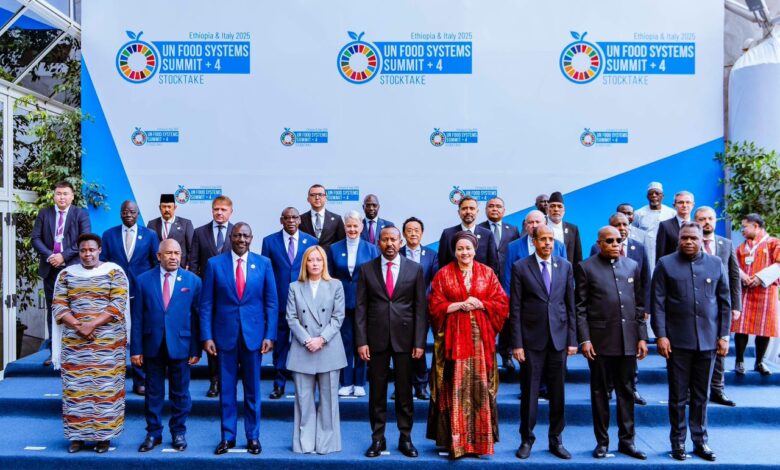
Speaking at the opening of the UN Food Systems Summit +4 (UNFSS+4) in Addis Ababa, Nigeria’s Vice President, Senator Kashim Shettima, said the country is leveraging modern technology—including artificial intelligence, geospatial analytics, and satellite-driven climate intelligence—to enhance agricultural production and ensure food security.
“The Fourth Industrial Revolution has gifted us tools that were once confined to the imagination. We are deploying them to monitor production, enhance transparency, connect producers to markets, and reduce waste across the value chain,” Shettima told global leaders at the summit.




He noted that Nigeria’s strategy goes beyond emergency response, highlighting the Presidential Initiative on Food Security which focuses on scaling up the cultivation of maize, rice, cassava, and wheat, supported by climate-smart innovations, financial inclusion for smallholder farmers, and expanded support services for women and youth.
The Vice President also referenced the National Food Systems Transformation Pathway, which guides targeted investments in infrastructure, capacity building, and agro-industrialization. He noted the development of Special Agro-Industrial Processing Zones in partnership with the African Development Bank and IFAD to drive rural economic growth.
Shettima called for collective African action, stating: “A broken food system in any part of the world diminishes the dignity of humanity. Let us rise with a shared purpose to build a world where no child sleeps hungry and food is not a luxury, but a human right.”
The summit, attended by heads of state, UN agencies, and multilateral organizations, served as a four-year progress review since the inaugural 2021 Food Systems Summit, with a renewed focus on building inclusive, sustainable, and resilient food systems.
Ethiopian Prime Minister Abiy Ahmed echoed the urgency for reform, calling for predictable concessionary finance to support rural transformation and emphasizing the link between climate change and hunger. “We are investing in local production, reducing dependence on imports, and building resilient food systems that place human dignity at the center,” he said.