President Ruto’s foot-in-the mouth disease — by Kelechi Deca
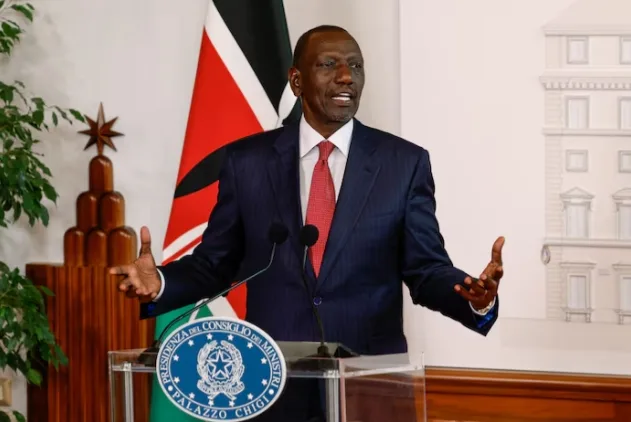
President William Ruto embarked on a series of reforms in the education sector which has positively impacted on human capital development in his country. Based on the World Bank’s Human Capital Index (HCI) 2023, Kenya has made a remarkable leap in the ranking.
So while addressing Kenyans living in Italy early this week, the only way President Ruto knew to pass the message of that achievement to them was to make a mockery of Nigerians.
According to him, “If you listen to a Nigerian speaking, you don’t know what they are saying – you need a translator,” while boasting that Kenyans spoke “some of the best English in the world”.
Ruto said Kenya’s education system produced strong English proficiency and that it was difficult to understand Nigerians when they spoke English.

“Our education is good. Our English is good. We speak some of the best English in the world. If you listen to a Nigerian speaking, you don’t know what they are saying. You need a translator even when they are speaking English,” he said, sparking laughter in the room.
Yet according to the 2025 EF English Proficiency Index (EF EPI), the top five ranked African countries for English proficiency are South Africa, Zimbabwe, Kenya, Zambia, and Nigeria.
So why did Mr. Ruto pick on Nigeria ? Is it because one of our brothers married one of his daughters? Did he make the use of a translator during the koito (bride-price) bargaining process as is the custom in his ethnic Kalenjin community in Kenya?
Mr. Ruto needs to be reminded that the same way he needs a translator to understand what I am saying may be the same challenge I experienced first time I visited his country.
Some think that Ruto was apparently responding to another irresponsible remark made by President Tinubu earlier this month when he said that “The fuel price is biting hard, but look around, let’s just thank God together that you are better off. Listen to them in Kenya… to what they are going through”.
The quality of leadership we have presently that has to take a dig at fellow African countries to validate their incompetence or incapacitation, is shameful to say the least.
President Ruto’s comments are not merely a diplomatic misstep—those pronouncements of his are a glaring symptom of a deeper pathology: an inferiority complex dressed in colonial hand-me-downs.
To stand before an audience in Europe and deride another African nation’s grasp of a foreign language is an unforced error. He willingly played the role of the house slave, policing who speaks the master’s tongue with sufficient “purity.”
And that was made even worse by the fact that those Kenyans in the audience who clapped and laughed as if they were watching a comedian, failed to grasp the deeper implications that Ruto’s comments betray a mind still tethered to the apron strings of empire.
Mr. Ruto’s remarks showcases a very deep inferiority complex rooted in colonial conditioning and coming from a leader whose country was at the cusp of one of the worst colonial experiences in Africa leaves much to be desired.
Thinking of him standing tall on that podium being proud of his ability to speak a language that was imposed by British bayonets, reminds me of poor Njoroge, in Ngugi Wa Thiong’o’s Weep Not Child.
Yet Ruto speaks as though elocution lessons at Oxford are the gold standard of African worth. By mocking Nigerians—whose creative, energetic command of English has birthed a global literary and cinematic juggernaut—Ruto reveals his own insecurity: a desperate need to prove he is “better” at being a colonial mimic.
This is the tragedy of the enslaved psyche: rather than celebrate Africa’s multilingual resilience, he ranks nations by how flawlessly they bow to London’s grammar rules.
What Ruto fails to grasp is that Nigerians have long moved beyond such petty colonialism. In Nigeria, we bend the English Language to our will, infusing it with pidgin and proverbs that mock the very idea of linguistic purity that Mr. Ruto pays obeisance to.
Ruto did not get the memo that Nigerians are not dancing to the same tune as Kenyans. And as Fela famously sang “Me and you no dey for the same category o”
Nigerians paid attention to the words of one of our erudite ancestors, Chinua Achebe who famously and acknowledged in his 1962 essay “The African Writer and the English Language” that : “Let no one be fooled by the fact that we may write in English, for we intend to do unheard of things with it.” Achebe succinctly highlights his intention to reshape the English language—the language of the colonizer—to carry the weight of African experiences, idioms, and culture.
Ruto’s sneer sounds like a teenager on Tiktok fawning over an abusive audience for validation. It is time African leaders abandoned this pathetic competition over who speaks “better English.”
This is coming months after another African president was seen grinning from ear to ear because a fellow president commended his ability to speak English.
Time has come for African leaders to grow up and stop misbehaving at the global stage instead they should focus on empowering our own languages, stories, and futures.
The master’s tongue will never set you free—only a mind that knows its own worth can do that. Ruto’s mockery is not wit; it is whips and chains worn as a necktie.