TRIBUTE: Homage to the hero, John Adelaja Aina — by Femi Adeola
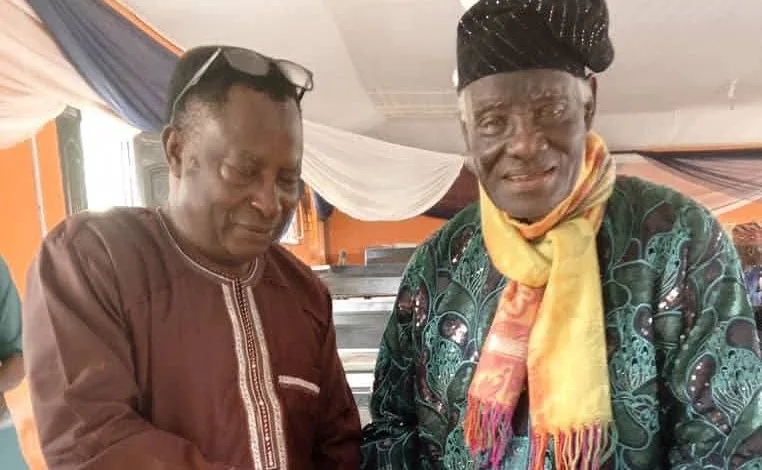
Many have written wonderful tributes and impressive accolades to Reverend Olugbenga Adelaja John Aina. While some did as spectators, many wrote as distant witnesses! Lana Alofe broke the progression. He was the first to write as an insider. His write-up was empirically objective and holistically comprehensive but not exhaustive.
My own submission will be compatibly comprehensive and corroborative to Lana’s holy treatise, by virtue of my opportune pedestal as his first child. Josie will never contest this; neither will Jerry doubt it. They won’t and can’t because of the J letter that alliterated the immediate family’s nomenclature– John, Jane, Josie, and Jerry, the hint of which may be briefly touched in this write-up, or better, in a biography of the Bach of Africa and Sebastian of the Black Race, which hopefully and somehow, will come later.
Why Bach and not Handel? What of Mozart and Beethoven? Truly, these are fathers of classical music; but none of them was a musical Polymath like Rev OLUGBENGA ADELAJA JOHN AINA. Only Johann Sebastian Bach matched his stature in organ playing; he ranked his status in musical arrangements and scored his style in conducting. His musical prowess exceeded these giants via his unbounded energy that knew no tiredness, his unconquerable strength that defied defeat, and his indomitable spirit– yes, his indomitable spirit that succumbed to no retreat.
Oh my God! Akanbi’s spirit was unquenchable! If it were, he would have gone at 50. He would have followed his closet allies– Rev Paul Ìbikúnle and Rev. Emmanuel Temisan, about 3 decades ago. But thank the good Lord, he kept holding forth till 90 short 3.

Who is Akanbi? He was the man who, at conception, faced challenges beyond the ordinary and still survived as a winner– even right from the womb. At birth, he surmounted obstacles that aren’t common to become a champion. In life, he faced unprecedented oddities as did Paul the Apostle– who had to bear the toughest pains, the roughest pangs, and the strongest perils from false friends.
Thank God, eventually, the Akanbi, like the great Apostle, had laid his sword at the foot of the cross, as Paul’s imperishable parting words reechoed: “I have fought a good fight, I have finished my course, I have kept the faith.”
My first contact with Baba John dated back to February 1979, when Rev Oshokoya (fondly called Bro T), was strategically saddling on him the full musical responsibility of the Apostolic Faith in Africa. Bro T used to handle any musical test– whether Voice, Rudiment or Instrument. Partly due to the aging health and the wisdom of de-monopolization, Bro T, like Moses of old, began nurturing Joshua of Baba John in musical matters!
Notably, Bro T used to conduct the immortal Hallelujah Chorus. There was a day when Rev Lucas Obakoya got lost in uncontrollable ecstasy. He stood up from his seat to literally lift Bro T off the podium, after a dramatic conducting of the Hallelujah Chorus.
1978 changed the equation as the dramatic performance of Bro T gave way to the acrobatic display of Baba John, the Enigma of Conducting. The African version of conducting, invented by Baba John, should become a continental, if not a global, legacy.
So, that day, while Bro T tested me on Rudiments of Music, he asked Baba John to take over my Voice Test. After about 5 minutes of effort to run me through a 5-octave portable organ, while I thought I qualified as a Bass, he nudged me to settle for a Baritone. On the assignment of the instrument, I preferred either Violin or Organ, but gently, he prodded me to go for cello– and he added: “You will understand why later.”
The second closer contact happened when Rev Kayode Oje unmistakably returned from overseas to Nigeria to caterpillar the musical landscape of Apostolic Faith in Nigeria. The visionary effort of Bro T to de-monopolize music eventually brought in Rev Dele Fakorede, who joined Baba John as an able assistant with a touch of academic excellence, a taste of psychedelic style, and an exhibition of youthful magnetism.
Either due to orthodoxical rail that wheeled the musical train in the church for three decades, or the burden of African mentality, the de-monopolization scheme was encumbered with some autocratic protocols and bureaucratic procedures until Rev Kayode Oje entered the scene to democratize the whole process.
The democracy of music triggered the incredible standardization and later, the decentralization of musical tests. Before this, the style of musical tests was akin to the Pool of Bethesda’s saga, which was a subject of tantalized expectation and unscheduled permutation. None of the infirms knew the visiting hours of the angel.
The same way was the musical tests modality. There were more than one case when students came to Lagos to be tested only to realize that Bro T was indisposed, and as such, had to return to their stations not tested. Nobody could predict when next to come!
This perhaps stands tall amongst the contributions of Rev Kayode Oje to the musical civilization of the church. He reorganized and formalized the whole thing into a predictable exercise and determinable event. Musical studies and instrument training became structured with definite schedules and categorical schemes. As this eradicated a lot of confusion, it eliminated many bottlenecks. After a successful model test of the musical democracy in Lagos, Bro T instructed the national expansion of the model.
Thus, my path physically crossed Baba John again in 1982 in Ado-Ekiti, Ekiti State. Before Rev Kayode Oje began the workshop, which eventually lasted till 2 am, Baba John desired a secretarial documentation of the proceedings. Lo and behold, his eyes spotted me, and spontaneously appointed me as the secretary to–in his own words– jot, collate, and send to him the minute details of all discussions in the meeting.
It is apt to mention here, in passing, that this was my first glimpse into the accommodating spirit and approachable soul of Baba John. First of all, the way he allowed Rev Kayode to take over the meeting was un-African. After the introduction, he stepped aside completely, without any unbridled interruption or unrestrained disruption. A suspicious or position-conscious leader won’t ever do that. But Baba John was different. He solely believes that WHAT WILL BE WILL BE.
To quote him in Yoruba, one of his favourite sayings is: “Fẹmi, ma yọ ara rẹ lẹnu. Ti o ba ti to asiko ati ya igbe, idi ma la’, being by English interpretation means– Fẹmi, don’t bother yourself. When it’s time to defecate, the anus will open. He struggled on nothing with anybody, but rather, calmly and always contented with his lot, almost to a fault.
My soberest moment with him was in February 1984, when I sat before the Panel for the Junior Orchestration Test. In an inexplicable drama of fate, as I placed the bow to play on my instrument– the cello, my hand was immovably stiff. While others were mocking me, he cautioned them and instead encouraged me to try again. Despite three trials, I still failed. He, together with my beloved music teacher Bro Julius Ozallo, encouraged me never to give up. And in August of the same year, I passed straight to the senior cadre, without any recourse to the Junior Orchestration Test again.
I guessed that was where and when the chords struck, which many artificial tensions attempted to break, but all efforts were to no avail, till he passed on, despite the physical distance of about 25 years.
Then came Baba John as my Organ Teacher. My opportunity to study at the University of Nigeria provided me with the academic opportunity to pursue further studies in Music.
Through the instrumentality of my gospel twin-brother– Prof (Rev) Adefemi Sunmonu, with whom we shared many similarities– educationally, marital, musically, etc, and Sister Chinwe, I had the academic exposure to Theory of Music, with particular specialization in Harmony, Composition, and Conducting.
After a 3-year dedicated study in music beyond Rudiment, Voice Production, and Sight Reading, I ventured to test my harmony knowledge with a melody piece inside the organ tutor– Smallwood titled SWEETLY FLOWING.
Late Brother Gbolade Odunsi was the Ondo/Ekiti State Music Director. He automatically adopted Baba John’s inspired decision to appoint me as the Secretary, as mentioned earlier.
Perhaps, he too had imbibed the accommodating soul from Baba John while he trained under him in Lagos. He, too, had an open spirit that was able to spot and encourage genuine talent. He accorded me the opportunity to use the State Choir as the standing Orchestra to perform my first arrangement in the Christmas Concert of 1984.
As a rule, then, the recordings of all concerts outside Lagos must be sent to Baba John. In the Christmas Concert tape recording sent to him, he listened to my arrangement and “queried” why it was included without his approval. A simple and careful explanation settled the matter. That was all. No harboured animosity! No reserved vendetta!! Never any foe; rather, ever friendly to all.
Instead of malice, he gave me the classical advice. “Fẹmi, if you truly want to be a composer of substance, you need to either master organ playing or have a Standing Orchestra to privately test any of your compositions or arrangements, before public performance’.
The advice settled to rekindle my smothering initial zeal to have an organ as my first instrument. Having passed to the Senior Orchestra in Cello, I embarked on a frenzy study and frantic training on Organ and Violin.
A testimony to Baba John’s photographic memory was displayed by himself in Enugu, where he visited in 1986. I was shocked when he quizzed me on how far I have gone with organ lessons. To reveal the man’s genuine mentorship spirit– in whom there’s no guile– he tested me the same day. He encouraged me to train more on the organ, and mandated me to make sure I trained Anne and John Okorie in Cello before I leave Enugu.
As providence would eventually orchestrate events, in 1987, I was posted to do my National Youth Service Programme in Lagos. That afforded me the opportunities to live intimately, move closely, and relate deeply with him.
Precisely in January 1988, he relocated my chair from the Cello section to the Organ side, so that I could be close to him to script any downloading musical inspiration before it evaporates. That was the genesis of the popular– Sing Hallelujah Amen
32) I sat beside him on the Organ as he was excavating on the keyboard, the introduction of the enduring and endearing local air–
d.m.d.m.l.s f.r
s.t.s t.d.m.l.s.
d.m.d.m.l.s f.r
s.t.s.t r t s.r.d.
It was there, and then, I truly understood the importance of the keyboard to melodical harmonization and chord progression. While the voice can sing only one part at the same time, and a good player can simultaneously play about 4 notes, a versatile organist can play 10 notes concurrently.
Perhaps, here lies the greatness of Baba John as an accomplished organist with no rival. He could play 15 notes at a time; 10 with the fingers on the keyboard and 5 via foot pedalling. The craziest of Baba John on the organ was on the pedals.
He eventually ensured that I sat and passed my organ test in August 1988. Armed with my academic knowledge in music and tutorials under the master, I sat on the giant’s shoulder to expand the Orchestra Score from the conventional 4 staff to 12, by splitting Violin, Flute, Clarinet, and Trumpet into two parts, while leaving Viola, Cello, Double Bass, and Bassoon on one part.
That began the unbreakable tie between Baba John and me. Biologically, he was old enough to birth me. Musically, he dwarfed my stature. Yet, he condescended to my status with unfeigned love and uncanny humility. The condescension was so much that we slept together many times, not only in the same room, but on the same bed.
We traversed the length and breadth of the country and the neighbouring countries, either to conduct tests or to participate in Christmas concerts.
A particular instance was 1990, when we attended and participated in 12 concerts between December 20 and January 2nd. While Jerry might have forgotten, Josie should still remember vividly how, after we finished the quadruplet annual Western circuit of Musical Concert Performances in Lagos, Ibadan, Ijebu-Ode, and Abẹokuta, we jetted out of the western zone, to criss-cross the notable Eastern branches of the church– from Enugu, to Aba, Port Harcourt, Ikot Ewang, Oron, etc.
While Rev Josiah Olubode Soyinka had unconditionally released me to do my NYSC Programme in Ondo State– precisely in Igede-Ekiti, after the then mandatory 3 weeks Camp orientation, the deft move of Rev Olumuyiwa Aaron Olamijulo reversed the release. He reasoned that my architectural education would be more useful in Lagos than in Igede-Ekiti.
After my NYSC service, I was to return to Ondo State to take an immediate appointment as a lecturer either at the old Ondo State Polytechnic, now Rufus Giwa Polytechnic, or the newly established Federal Polytechnic, Ado-Ekiti. However, on August 20— the second to the last day of the 1988 Camp Meeting, Baba John called me to the Prayer Room for a discussion that would rewrite history.
Just as Rev Olamijulo reasoned, he too believed that my staying back in Lagos after the service year would be more relevant to the Apostolic Faith musical world. He gave me three days to think about it. After critical consideration of his suggestion, I conceded on a 5- condition terms:
(a) Full permission to formalize the casual scoring system on the platform. The acceptance of this condition was what led to the formation of the Scorer Squad– comprising 2 Scorers per state. The Scorers Squad wasn’t formed and run without the full approval of the then Africa Overseer– Rev Soyinka and his General Secretary– Rev Olamijulo.
(b) Empowerment to staff notate the Collected Gospel Songs, in the bid to spare the Choir the trouble of having to buy and stock many song books inside “kolo” — the likes of CMS, Broadman Tabernacle, etc, for unpredictable congregational songs.
(c) Editing, rewriting, and turning the over 20 years compositions and arrangements into standard books like the popular Broadman, Gospel Songs, Heavenly Highways, Tabernacle, etc.
(d) Continuation of my breasted mission to compose 2 songs each for the weekly Apostolic Faith’s Sunday School Lessons. The school lessons are numbered 468. I had only reached about 20 before I left Ekiti State to Lagos for my NYSC Programme.
(e) Embracement of my vision: to eradicate Poverty from the Choir.
That God was the Initiator of the Scorers’ Squad couldn’t be more validated than the immediate provision of the Caleb and Joshua abled assistants, who happened to be my “Aburos”, first by nativity and second by affinity.
Even though Lana Alofe worked closely with me for almost two decades, he didn’t know this: he is probably unaware that God used him to change a religious misconception in me. I used to believe in the general dogma that we brought nothing from heaven, and that we would eventually take nothing back from the earth to heaven.
From Lana, I understood perfectly that “the gift (talent) of a man was given to and packaged in him, by God himself, not after birth but as part of the soul.
According to the wise man, King Solomon, the gift was the key to the health and wealth of the individual, which is meant to open any door, and where it is inserted and turned, prosperity is ensured.
Lana brought musical composition and scoring from heaven. My prayer is that he wouldn’t die with it wasted, because he would account for it in heaven. In him, I found a raw and ready heart to kick-start the arduous task of scoring over 20 years of Baba John’s compositions and arrangements. With few private tutorials and an altruistic spirit, Lana caught the fire to beat my mentorship in scoring graphical precision. The collaboration eventually was carried to the platform, where he became my assistant Junior Choir Leader.
Joshua’s Associate was and is Tony Ademuyiwa– a dogged and rugged Prince from Ondo State. His enlistment into the Scorers’ Squad was divine and destined. As a divine arrangement provided him the opportunity to do his NYSC Programme in the church, technical evolution favoured his scoring flavour. He was the first to learn and master the use of Music software.
With him on board, the laborious manual scoring system gave way to quicker, easier, cheaper, and neater electronic options.
The pilot model he worked upon was the Collected Gospel Song, which used to be an untidy bound volume of collated photocopies from different songbooks with cluttered settings. Tony spent his whole year of national service on this laudable project. I am not sure if the book is now in use.
If not, that is the big barrier. And this will lead me to the 5th reason why I agreed to stay in Lagos after my service year– ERADICATION OF POVERTY FROM THE CHOIR. This mission is too audacious for anybody to believe. While it didn’t take me any stress to convince Baba John, the big hurdle to cross was how to sell the idea to the Africa Overseer.
I routed the idea through the Overseer’s General Secretary– Rev Olamijulo, who Rev Soyinka trusted and regarded so much. Because Rev Olamijulo has one rare virtue– he’s a good listener, and being a scholar himself, it didn’t take me much talking to convince him.
Supporting myself with the powerful biblical submission that– THERE SHOULD BE NO POOR AMONG YOU (Deuteronomy 15:4) and that a man’s gift maketh room for him, and bringeth him before great men, and in consequence, whithersoever it turneth, it prospereth” (Proverbs 17:8; 18:16), I successfully defended the idea with Rev Olamijullo, who sagaciously sold it to the Africa Overseer.
While Tony, for one year, spent days and nights on the Collected Gospel Songs, Lana and 2 Scorers from each State consolidated efforts to staff notate the over 20 years of compositions and arrangements of Baba John. While I coordinated both, I also wrote a fairly comprehensive book on Voice Production to complement Rev Kayode Oje’s book on Rudiments of Music.
Tony needs to be asked; Lana can answer whether the books have seen the light of day. Brother Seyi Oduyale is in the best position to clarify why the Voice Production’s Book that left the manuscript stable to his father’s printing press– Mustard Printers, with the draft copy printed, bound, but the mass duplication never happened till today.
Eradication of Poverty from a group? Yeah– it’s an ambitious mission, but it’s achievable.
The Ministry reasoned with my logic.
That although, part of the Word says– FREELY YE RECEIVE, FREELY YE GIVE, since we do buy the same Word of God in the Bible format, and the choristers used to buy different song books, and heaven didn’t fall, there would be no departure from any old land mark, if we sell the staff notation edition of the Collected Gospel Songs, first to the Choir, and to as many people that might even want to buy in advance for yet unborn children. In the Apostolic Faith world alone, millions will be sold.
I want to let the church know and realize the bundle of wealth personified in the man called Olugbenga Adelaja John Aina:
“Akanbi ọmọ,
Akanda eniyan,
Ade ki ilu mọ
Ọkan soso Araba
Ẹkùn ọkọ Duru
Ti ko ṣe lu, Ko ṣe pa, Àfi ìgbà tí, Ọlọjọ dé”.
The proposed two song books on Baba John’s Works, the Orchestration Volume and the Vocal edition, would have sold billions in the Pentecostal and Charismatic fronts of Christendom,worldwide.
But behold, the modern Jubal of Organ, the Psalmist of our time in Medley arrangements– whose entire body system is a Tree of Prosperity, left us with parboiled talents, without witnessing the dawn of the day, when none of the chorister whom he laboured and toiled on for 67 solid years) should be poor!
–Adeola is a music scorer, composer and arranger